In This Guide
- What the 78.5% Number Actually Means
- The Occupancy Gap: Why KL and Selangor Lag
- Where Office Demand Is Actually Concentrated
- How Office Investment Financing Works in Malaysia
- The SST and Cost Side Nobody Mentions
- A Worked Example: Yield on a Strata Office Unit
- Who Should (and Shouldn't) Consider Office Space
- FAQs
"Office is dead" has been the lazy takeaway from every remote-work headline since 2020. So when Malaysia's Finance Ministry quietly reported that purpose-built office (PBO) occupancy actually rose in H1 2026, it caught a few investors off guard. Rose to what, though, and rose where — that's the part the headline number doesn't tell you, and it's the part that actually matters if you're thinking about buying office space rather than just reading about it.
This isn't a "commercial office is the next hot asset class" piece. It's a look at what the 78.5% figure really covers, why Kuala Lumpur itself is still lagging the national trend, and what it actually costs — in financing terms and in SST — to own a slice of it.
What the 78.5% Number Actually Means
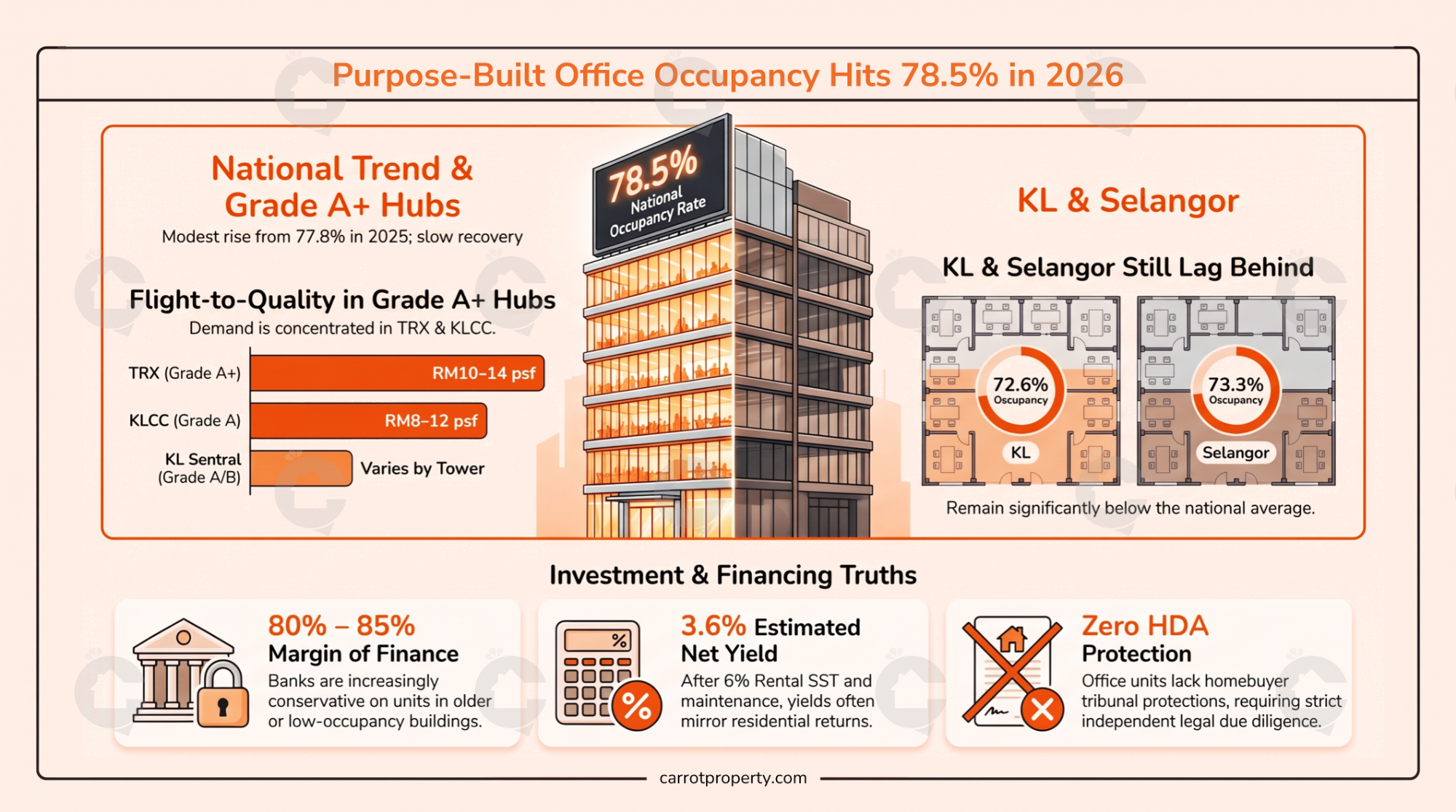
According to Second Finance Minister Amir Hamzah's H1 2026 property market briefing, the overall occupancy rate for purpose-built offices — combining both private and government-sector buildings — rose to 78.5% in the first half of 2026, up from 77.8% in H1 2025. It's a modest gain, roughly seven-tenths of a percentage point, but it continues a slow climb that NAPIC's own 2025 data already showed, with the national PBO occupancy average sitting around 78.1% at end-2025 within a broader 72.3%–78.1% range across regions.
The honest read: this is a national blended figure, and blended figures flatten a lot of local variation. It tells you the overall office market isn't shrinking — vacancy isn't getting worse nationally — but it doesn't tell you whether the specific building, floor, or district you're eyeing is one of the ones absorbing tenants or one of the ones still bleeding them.
The Occupancy Gap: Why KL and Selangor Lag
Here's the part that should give a Klang Valley-focused investor pause: at end-2025, Kuala Lumpur's own office occupancy sat at just 72.6%, and Selangor at 73.3% — both meaningfully below the national average that's supposedly climbing. In other words, some of the national uptick is being carried by states outside the country's biggest and most expensive office market, not by KL itself.
The gap is largely a flight-to-quality story. Older Grade B and C towers — many built during the 2010s office boom — are the ones still struggling to fill floors, while newer Grade A and Grade A+ developments are absorbing tenants who are consolidating from older stock into better-specified space. We touched on a related version of this dynamic in Commercial vs Residential Property Investment in Malaysia 2026 — the same oversupply pressure sitting on the SOHO/serviced-apartment segment is showing up here too, just in office form.
Where Office Demand Is Actually Concentrated
The flight-to-quality pattern shows up clearly when you look at where rental rates are actually holding firm. Grade A and Grade A+ buildings in a handful of Klang Valley locations are commanding premiums that older stock simply can't match:
| Area | Grade | Typical Rental (psf/month) | Why Tenants Are There |
|---|---|---|---|
| KLCC | Grade A | RM8 – RM12 | Petronas Twin Towers, Menara Maxis, Ilham Tower, 90+ Grade A buildings |
| TRX | Grade A+ | RM10 – RM14 | LEED-certified towers, direct MRT access, KL's newest financial district |
| KL Sentral | Grade A/B | Varies by tower | KTM, ERL, Monorail and Rapid KL all interchange here |
| Bangsar / Mont Kiara | Grade B, mixed | Mid-to-upper range | Popular with professional services firms and regional teams |
Notice what these four areas have in common: transit access, newer specifications, or both. That's the flip side of the KL/Selangor occupancy gap — it's not that "KL office" is universally weak, it's that demand has concentrated hard into a smaller pool of well-located, well-specified buildings, leaving everything else to absorb the vacancy.
How Office Investment Financing Works in Malaysia
Commercial property financing runs on different rules from residential. There's no Bank Negara-mandated loan-to-value cap on commercial purchases — unlike residential loans, which are capped at 90% for your first two properties and drop to 70% from the third onward. In practice, banks commonly offer 80% to 85% margin of finance on commercial property based on their own internal risk policy, occasionally stretching to 90% for strong applicants or owner-occupied premises.
The reference rate banks use for pricing these loans is the Standardised Base Rate, sitting at 2.75% p.a. since July 2025 — consistent with Bank Negara holding the OPR at 2.75% for a fifth straight meeting as of September 2026. But margin of finance is where office buyers should pay closest attention: banks tend to get noticeably more conservative on units in older buildings, mixed-use developments with low occupancy, or upper-floor units in towers where the tenant mix looks thin. If the building itself is running below the occupancy figures in the table above, expect the bank's valuer to flag it, and your margin to shrink accordingly.
The SST and Cost Side Nobody Mentions
Two cost items catch first-time commercial buyers off guard, and neither applies to a typical residential purchase.
Rental SST: Since 1 July 2025, rental and leasing income on commercial property — including office space — has been subject to Service Tax, initially at 8%, then reduced to 6% effective 1 January 2026. Small landlords get some relief: the registration threshold for exemption was raised to RM1.5 million in annual rental sales, which covers most individual investors owning one or two units. There's also a transitional carve-out — a non-reviewable lease contract signed and stamped by LHDN on or before 9 June 2025 stays exempt until 30 June 2026, with SST kicking in from 1 July 2026 onward. If you're buying a tenanted unit, ask to see the lease's stamping date; it changes your actual net yield.
No HDA protection: Pure office, SOVO, and SOFO units fall outside the Housing Development (Control and Licensing) Act — the same protection gap we covered in Buying Commercial Property in Malaysia: How to Protect Yourself Without HDA Coverage. There's no Tribunal for Homebuyer Claims and no Schedule H contract to fall back on if a developer under-delivers, so the due-diligence steps in that guide — your own lawyer, a title/land search, checking the developer's litigation and SSM history — apply just as much to an office purchase as to a commercial shop lot.
A Worked Example: Yield on a Strata Office Unit
To be clear, this is an illustrative example using representative market ranges — not the pricing of any specific project — to show how the pieces above actually stack up against each other.
| Item | Illustrative Figure |
|---|---|
| Unit size | 800 sq ft |
| Purchase price | RM750,000 |
| Financing at 85% margin | RM637,500 loan / RM112,500 down payment |
| Monthly rental (illustrative, Grade B market range) | ~RM2,800 (RM33,600/year) |
| Gross yield | 4.48% |
| Less: 6% rental SST, maintenance/sinking fund, assessment & quit rent | ~RM6,500/year |
| Net yield | ~3.6% |
That net figure sits in a similar range to a typical residential condo — which is worth sitting with for a moment. Office space doesn't automatically out-yield residential once SST, higher maintenance costs, and financing conservatism are factored in; the case for it usually rests on capital discipline (business owners buying for their own use) or a genuinely well-located asset in the demand pockets covered above, not on a blanket yield advantage. For a fuller side-by-side, see our Commercial vs Residential Property Investment breakdown.
Who Should (and Shouldn't) Consider Office Space
- 1Business owners buying for their own useRemoving rent as a fixed monthly cost and building equity in an asset you're occupying anyway is the clearest, lowest-risk case for office ownership — and owner-occupiers often qualify for the higher end of bank financing margins.
- 2Investors comfortable underwriting a specific buildingGiven how much the national and even state averages flatten real variation, this only makes sense for buyers willing to check a specific tower's occupancy, tenant mix, and lease stamping dates before committing — not buyers investing off the headline 78.5% figure.
- 3First-time property investorsProbably not the place to start. No HDA protection, no BNM-capped financing certainty, and higher SST/maintenance costs stack several extra variables onto what's already a bigger commitment than most first purchases — a residential unit is the more forgiving entry point.
FAQs
Is Malaysia's office occupancy rate actually improving in 2026?
Nationally, yes — the Finance Ministry's H1 2026 data shows purpose-built office occupancy at 78.5%, up from 77.8% in H1 2025. But this is a national blended figure across private and government sectors; it doesn't guarantee occupancy is rising in every state or building.
Why is KL office occupancy below the national average?
KL sat at 72.6% and Selangor at 73.3% at end-2025, both below the national figure. The gap reflects a flight-to-quality trend — tenants consolidating out of older Grade B/C towers into newer Grade A and Grade A+ buildings in areas like TRX and KLCC, leaving older stock to carry most of the vacancy.
How much deposit do I need to buy an office unit in Malaysia?
Commercial property has no BNM-mandated loan-to-value cap. Banks commonly offer 80–85% margin of finance, occasionally up to 90% for strong applicants or owner-occupiers — meaning a typical down payment runs 15–20% of the purchase price, though older or low-occupancy buildings often get a smaller margin.
Is rental income from office space subject to SST?
Yes. Commercial rental and leasing income has been subject to Service Tax since 1 July 2025, reduced from 8% to 6% effective 1 January 2026. Landlords under RM1.5 million in annual rental sales are exempt, and leases stamped on or before 9 June 2025 stay exempt until 30 June 2026.
What's the difference between buying a SOHO and a pure office (SOVO/SOFO) unit?
SOHO units are protected under the Housing Development Act (HDA) like residential property. Pure office, SOVO, and SOFO units are not — there's no Tribunal for Homebuyer Claims or Schedule H contract, so buyers need their own lawyer and due diligence steps regardless of which one they're buying. See our full guide on protecting yourself without HDA coverage.
This article is for general guidance only and does not constitute legal or financial advice. Figures referenced are drawn from publicly reported Finance Ministry, NAPIC/JPPH, and government sources current as of September 2026 and are subject to change as new reporting periods are released. The worked yield example is illustrative only, using representative market ranges rather than the pricing of any specific development. Always verify current figures, building-specific occupancy, and financing eligibility directly with a licensed agent, bank, or financial institution before making a purchase decision.
Let's check if the numbers actually work for the building you're eyeing
Carrot Property can walk you through a specific building's occupancy, financing options, and real net yield — before you commit to anything. No hard sell, just straight answers.
- Verified Klang Valley listings
- Honest pricing, no hard sell
- Straight answers on financing options