In This Guide
- Why "Which Yields More" Is the Wrong First Question
- Rental Yield: Commercial vs Residential
- Financing: Loan Margins, Rates & Terms
- Legal Protection: HDA Coverage vs None
- Stamp Duty, RPGT & Ongoing Costs
- Vacancy & Liquidity Risk
- Worked Example: Same RM500,000 Budget, Two Outcomes
- Side-by-Side Comparison
- Which One Fits Your Situation?
- FAQs
Ask around at any property talk or investor WhatsApp group in Klang Valley right now, and you'll hear the same pitch: "commercial gives better yield what, why still buying condo." It's not wrong exactly — commercial property in Malaysia genuinely does tend to rent out at a higher percentage return than residential. But a bigger headline yield doesn't automatically mean a better investment, and plenty of buyers who chased the number alone have ended up with a unit that's harder to finance, harder to sell, and sitting empty longer than they budgeted for. Let's walk through what actually differs — properly, not just the yield line.
Why "Which Yields More" Is the Wrong First Question
Commercial and residential property in Malaysia aren't really two flavours of the same investment — they run on different financing rules, different legal protections, and different tenant markets entirely. A shop office in a strong retail node and a condo unit in a saturated high-rise pocket aren't comparable just because they're both "property." The honest starting point isn't "which type is better" — it's "which type fits your cash position, risk tolerance, and how long you can hold if things don't go to plan." Everything below is there to help you answer that, not to crown a winner.
Rental Yield: Commercial vs Residential
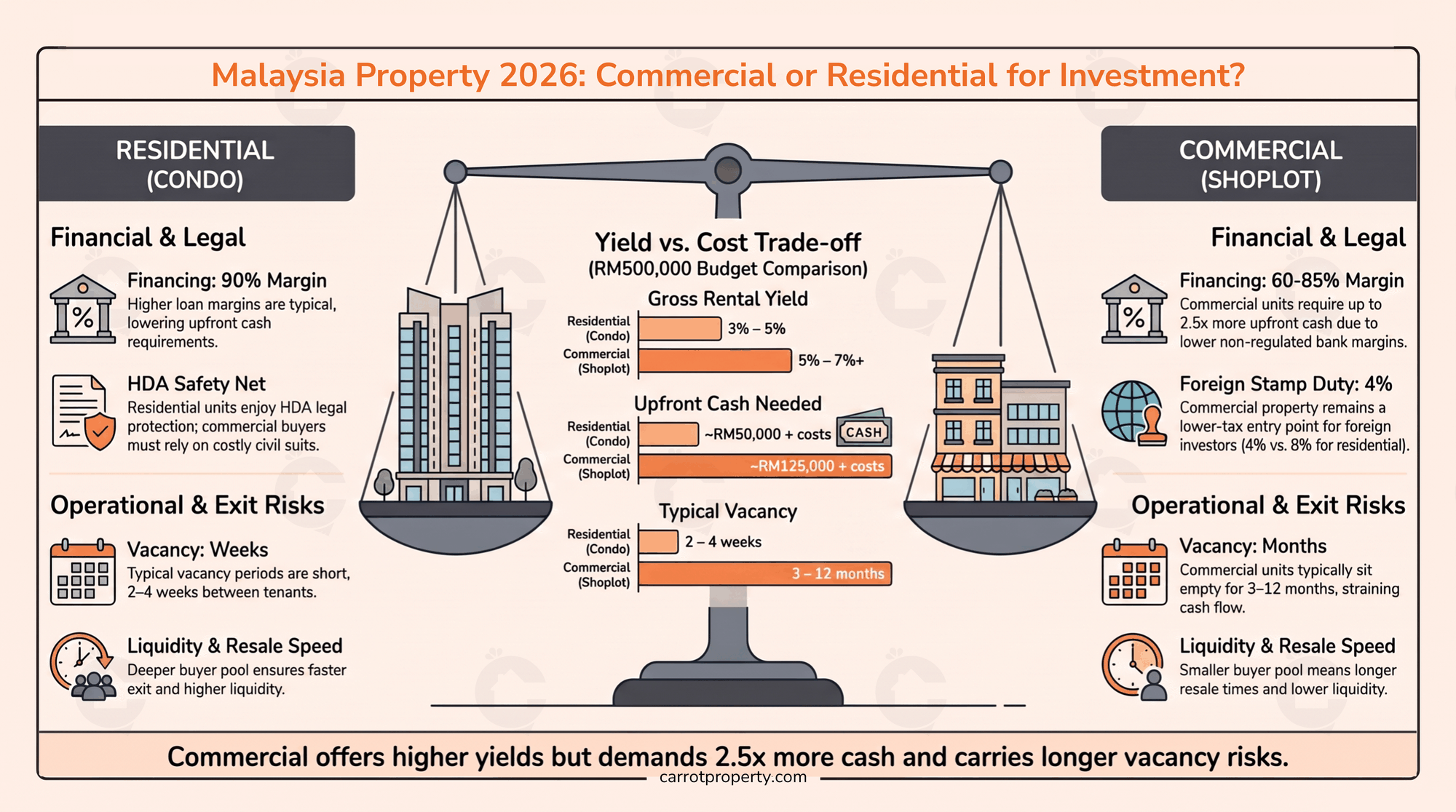
On paper, commercial property does win this round. Gross rental yields for residential apartments in Malaysia averaged around 3–5% through 2026, with well-located units in strong rental pockets touching just above 5%. Commercial-titled units — shop offices, SOVO, SOFO — regularly quote gross yields in the 5–7% range, and some well-let units in established commercial nodes push higher still.
The gap is real, but it's a gross gap. Commercial units typically carry higher maintenance and sinking fund contributions, quit rent, and — depending on how the unit is used and let — potential Sales and Service Tax exposure on rental income above the registration threshold. We covered the specifics of who pays what on the maintenance side in our guide to commercial property maintenance fees in Malaysia, including the SST exemption that took effect from July 2026. Once those extra costs are netted out, the gap between commercial and residential net yield is usually narrower than the gross headline number suggests — still generally in commercial's favour, just not by as much as the marketing implies.
Financing: Loan Margins, Rates & Terms
This is where the two paths diverge sharply, and it's arguably a bigger factor than yield for most buyers' actual affordability.
Residential property financing is governed by Bank Negara Malaysia's loan-to-value rules, which is why first-time buyers can often secure up to 90% margin of finance on their first home. Commercial property financing isn't bound by the same BNM framework — banks set commercial margins based on their own internal risk assessment, and typically offer somewhere between 60% and 85% of the purchase price, occasionally stretching to 90% for strong applicants or owner-occupied purposes. That means a commercial purchase usually demands a meaningfully bigger cash outlay upfront relative to price, even before you account for the higher entry price some prime commercial units command.
Legal Protection: HDA Coverage vs None
This is the difference buyers most often underestimate. Residential property bought off-plan is protected under the Housing Development (Control and Licensing) Act 1966 — a standardised Schedule H contract, a statutory progress payment schedule, a guaranteed defect liability period, 10% per annum Liquidated Ascertained Damages for late delivery, and access to the low-cost Tribunal for Homebuyer Claims if something goes wrong.
Commercial-titled units — SOVO, SOFO, standalone shop offices — fall outside HDA entirely. There's no prescribed contract format, no guaranteed LAD rate, and no Tribunal route; your only recourse if a developer delays or defaults is an ordinary civil suit. We broke down exactly what that gap means and how to protect yourself in our guide to buying commercial property in Malaysia without HDA coverage — it's essential reading before signing any off-plan commercial SPA.
Stamp Duty, RPGT & Ongoing Costs
Real Property Gains Tax applies the same way regardless of property type — it's based on how long you've held the property, not what category it's titled under, with rates stepping down the longer a Malaysian owner holds before disposing. Stamp duty on the transfer instrument follows the same tiered ad valorem scale for both types too — but two things genuinely differ:
- Foreign buyer stamp duty. Budget 2026 raised the stamp duty rate for foreign purchasers of residential property from a flat 4% to 8%. Commercial and industrial property was left untouched at 4% — which has made commercial units a relatively more attractive entry point for some foreign investors specifically because of this gap.
- First-time buyer exemption. The 100% stamp duty exemption for first-time buyers (extended to 31 December 2027) applies only to residential property priced at RM500,000 and below — see our full breakdown in Stamp Duty Exemption for First-Time Homebuyers. There's no equivalent exemption on the commercial side.
Vacancy & Liquidity Risk
This is where commercial's yield advantage gets tested hardest. Residential vacancy between tenants in a decent location typically runs 2–4 weeks. Commercial vacancy is a different animal — 3 to 12 months isn't unusual, and in a weak location or during a soft patch it can stretch well beyond a year. Office and retail submarkets in parts of Klang Valley have carried meaningfully elevated vacancy through 2025–2026, a reminder that "commercial" isn't a single uniform market — location and asset quality matter enormously more here than they do for residential.
Resale liquidity follows the same pattern. There are simply more buyers competing for a well-located condo unit than for a shop office or SOVO — which means commercial property can take noticeably longer to sell when you eventually want out, and pricing power tends to sit more with the buyer in that negotiation. We looked at how this risk plays out across the current oversupply picture in Malaysia Property Overhang 2026, where the unsold-unit risk profile for residential and commercial-titled stock diverges noticeably.
Worked Example: Same RM500,000 Budget, Two Outcomes
Say you have RM500,000 to deploy and you're weighing a residential apartment against a commercial shoplot at the same purchase price.
| Item | Residential (4.5% gross yield) | Commercial (6.5% gross yield) |
|---|---|---|
| Purchase price | RM500,000 | RM500,000 |
| Typical loan margin | 90% | 75% |
| Cash needed upfront (down payment + costs) | ~RM50,000 + costs | ~RM125,000 + costs |
| Annual gross rental | RM22,500 | RM32,500 |
| Typical vacancy between tenants | 2–4 weeks | 3–12 months (higher in soft locations) |
| Cash outlay for the higher yield | ~2.5x more upfront cash for the commercial unit, before accounting for higher opex and longer possible vacancy gaps | |
The higher yield is real — but it's funded by roughly 2.5x more cash sitting idle upfront, a longer potential vacancy runway, and no HDA safety net if you're buying off-plan. None of that makes commercial the wrong choice; it just means the yield number by itself is an incomplete comparison.
Side-by-Side Comparison
| Factor | Residential | Commercial |
|---|---|---|
| Typical gross rental yield | 3–5% | 5–7%+ |
| Typical loan margin | Up to 90% (BNM-regulated) | 60–85%, bank-by-bank |
| Legal protection (off-plan) | HDA — Schedule H, LAD, Tribunal | None by default — negotiate everything |
| Foreign buyer stamp duty | 8% | 4% |
| First-time buyer stamp duty exemption | Yes, up to RM500,000 | No |
| Typical vacancy between tenants | 2–4 weeks | 3–12 months, longer in weak locations |
| Resale liquidity | Deeper buyer pool | Thinner buyer pool, slower resale |
Which One Fits Your Situation?
Residential tends to suit you better if: you're a first-time or early-stage investor, want to maximise loan margin and preserve cash, value the HDA safety net, or want a deeper resale market when you eventually exit.
Commercial tends to suit you better if: you have a larger cash buffer for a smaller loan margin, can tolerate longer vacancy stretches without cashflow strain, are buying in a genuinely strong, well-established commercial node — not just a cheaper-looking new launch — and are comfortable doing (or paying a lawyer for) the extra due diligence HDA would otherwise have handled for you.
WCity VOUG — Commercial Shoplots, OUG
A pre-launch commercial shoplot development by WCT in the OUG/Old Klang Road corridor — a useful reference point for evaluating what a genuine commercial-node location looks like versus a speculative one.
View WCity VOUG →Plenty of investors hold both in a diversified portfolio, using residential for stability and commercial for yield — rather than treating it as an either/or decision.
FAQs
Is commercial property really more profitable than residential in Malaysia?
Gross rental yield is usually higher for commercial — typically 5–7% versus 3–5% for residential — but that gap narrows once you account for higher maintenance costs, lower loan margins, and longer typical vacancy periods. Net profitability depends heavily on the specific unit and location.
Why is commercial property financing harder to get than residential?
Commercial loans aren't bound by Bank Negara Malaysia's residential loan-to-value rules, so banks set margins based on their own risk assessment — typically 60–85% versus up to 90% for many residential first-home purchases. This means a bigger cash outlay upfront for the same purchase price.
Does the Housing Development Act protect commercial property buyers?
No, not for SOVO, SOFO, or standalone shop offices. SOHO units are a partial exception since they're usually built on residential-category land. See our full guide on protecting yourself buying commercial property without HDA coverage.
Is commercial property harder to resell than residential?
Generally yes. The pool of buyers and financing options is narrower for commercial-titled property, which typically means a longer time on market and less pricing power for the seller compared to residential.
Should a first-time property investor start with commercial or residential?
Most first-time investors are better served starting with residential, given the higher loan margin, HDA protection, and deeper resale market. Commercial can make sense as a second or later purchase once you have more cash buffer and risk tolerance.
Does the foreign buyer stamp duty difference make commercial property more attractive to foreigners?
It's a factor — residential stamp duty for foreign purchasers rose to 8% in 2026 while commercial stayed at 4% — but it shouldn't be the deciding factor on its own. Financing terms, legal protection, and vacancy risk still apply regardless of buyer nationality.
This article is for general guidance only and does not constitute legal or financial advice. Yields, loan margins, tax rates, and vacancy figures vary by project, bank, and location — always verify current numbers with your bank, lawyer, and a licensed financial adviser before making an investment decision.
Get straight numbers on both before you commit
Carrot Property can walk you through real yield, financing, and risk comparisons across our current residential and commercial listings — no hard sell, just honest numbers.
- Verified Klang Valley listings
- Honest pricing, no hard sell
- Straight answers on yield and risk