In This Guide
Buy a residential unit in Malaysia off-plan, and if the developer runs into trouble halfway through construction, there's a government tribunal built specifically to fight your corner — no lawyer required, capped fees, a fast track to a decision. Buy a shop office, a SOVO, or a SOFO instead, and that safety net simply isn't there. You're on your own, working with whatever terms you managed to negotiate into the contract.
More Malaysian buyers are looking at commercial-titled property right now — entry prices are often lower than comparable residential stock, and January 2026's stamp duty hike for foreign purchasers (now 8%, up from a flat 4%) applies only to residential property, not commercial. That's made commercial units a relatively more attractive entry point for some investors. But the legal protection gap that comes with commercial title catches a lot of first-time commercial buyers off guard — usually only after something has already gone wrong. Here's what's actually different, and how to protect yourself properly before you sign anything.
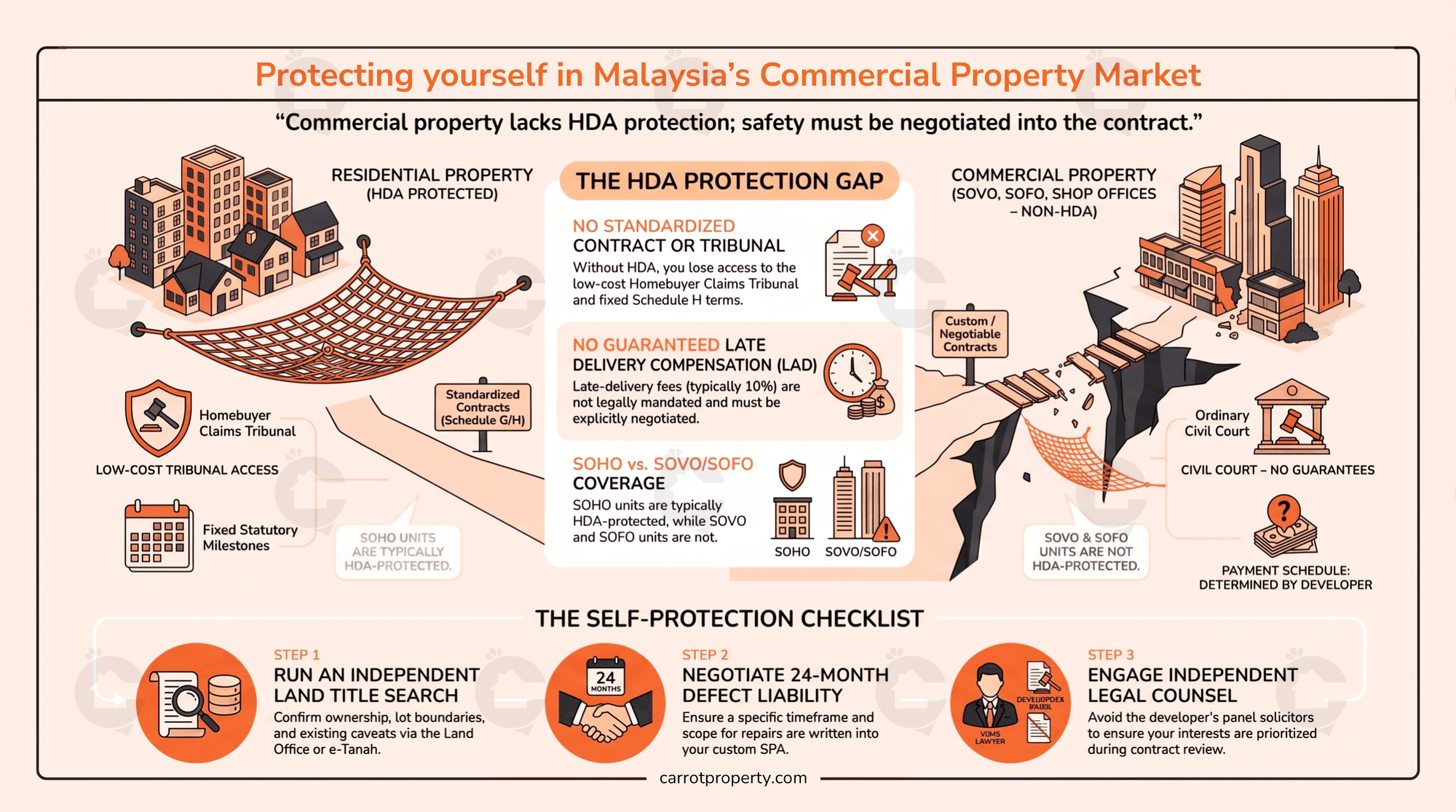
Why Commercial Buyers Don't Get the Same Safety Net
The Housing Development (Control and Licensing) Act 1966 — usually just called the HDA — is the law that gives Malaysian homebuyers most of the protections they take for granted: a standardised contract, a mandated payment schedule tied to construction progress, a defect liability period, and a tribunal to resolve disputes without going to court. It was written with one specific problem in mind: people paying for homes years before they're built, with no guarantee the developer would actually deliver.
That protection was designed around housing, though — not commercial space. And that distinction matters a lot more than most first-time commercial buyers realise going in.
What the Housing Development Act Actually Covers
HDA protection applies to properties built and sold under a residential title, including developments sold off-plan before completion. In practice, this gives a covered buyer:
- A prescribed, standardised Sale and Purchase Agreement (Schedule G for landed property, Schedule H for strata-titled units like condos and apartments) — the developer cannot quietly rewrite the core terms
- A statutory progress payment schedule, tied to certified construction milestones rather than the developer's own preferred timeline
- A guaranteed defect liability period after handover
- A right to claim Liquidated Ascertained Damages (LAD) for late delivery — under Schedule H, calculated at 10% per annum of the purchase price for every day past the contractual delivery date
- Access to the Tribunal for Homebuyer Claims (Tribunal Tuntutan Pembeli Rumah) — a low-cost, relatively fast dispute resolution route that doesn't require hiring a lawyer
These protections exist because the statute writes them in. A developer selling under HDA cannot simply leave them out of the contract — the format itself is regulated.
Which Properties Fall Outside HDA Protection
HDA only covers residential-title property. That leaves out most commercial-titled stock entirely:
- SOVO (Small Office / Versatile Office) and SOFO (Small Office / Flexible Office) — not covered
- Standalone shop offices, retail lots, and office suites — not covered
- Industrial units and warehouse lots — not covered
- Secondary-market (subsale) property generally, since HDA is specifically an off-plan protection — not covered regardless of title type
What You Lose Without HDA: Tribunal, Schedule H, and LAD
If your unit falls outside HDA, here's what that gap actually looks like in practice:
Specifically, you lose:
- A prescribed contract. There's no Schedule H equivalent for commercial title. The payment schedule, delivery deadline, defect liability period, and compensation terms are all whatever you and the developer agree to — and whatever isn't explicitly written in, you don't have.
- Guaranteed LAD. A residential buyer under Schedule H is entitled to 10% per annum on the purchase price for late delivery, by law. A commercial SPA might set a lower rate, cap the total payout, extend the grace period, or omit late-delivery compensation altogether — and unless you negotiate otherwise, that's legally binding.
- Statutory progress payment protection. Residential buyers pay in stages tied to certified construction milestones under HDA's structure. Commercial developers can propose a front-loaded schedule instead, increasing your exposure if the project stalls early.
- A guaranteed defect liability period. Many commercial developers voluntarily offer one similar to residential norms (commonly around 24 months) — but it isn't required by law, so confirm it's actually in your contract rather than assuming it applies.
Step-by-Step Due Diligence Before You Sign
None of this means commercial property is a bad investment — it just means the protections that residential buyers get automatically, commercial buyers have to build for themselves. Here's the sequence to follow before signing anything:
- 1Run a land title searchSearch the title at the relevant Land Office or via e-Tanah to confirm the registered owner, lot boundaries, existing charges, and any caveats before you commit.
- 2Check the developer's track recordSearch their SSM record for signs of prior litigation, winding-up petitions, or a history of delayed and abandoned projects.
- 3Confirm the zoning and land categoryVerify with the local authority (e.g. DBKL, MBPJ) that the land's approved category genuinely matches "commercial" and your intended use.
- 4Engage your own lawyerUse a lawyer independent of the developer's panel solicitor to review the SPA — since the format isn't standardised, this review matters far more than it does for a Schedule H contract.
- 5Check the strata title statusConfirm whether individual strata titles have already been issued or are still pending — this affects your financing options and how easily you can resell later.
- 6Negotiate LAD and defect liability explicitlySince neither is guaranteed by law, get specific rates, formulas, and timeframes written into the SPA rather than assumed.
- 7Confirm CF/CCC requirementsCheck the Certificate of Completion and Compliance status before you plan to operate a business from the unit.
What to Negotiate Into Your SPA
Because a commercial SPA isn't a prescribed statutory form, everything that protects you has to be written in deliberately. At minimum, push for:
- A clearly defined LAD rate and formula for late delivery, ideally benchmarked against the Schedule H standard even though it isn't legally required
- A defined defect liability period stated explicitly, with the scope of what's covered spelled out
- A milestone-based progress payment schedule tied to architect-certified construction stages, not a front-loaded one
- Conditions precedent covering your financing approval and any regulatory consents needed before the deal is binding
- A clear, specific definition of "vacant possession" and the condition the unit must be handed over in
As we covered in our look at Malaysia's property overhang numbers, risk profiles diverge sharply between residential and commercial-titled stock — this legal protection gap is a big part of why. Ownership costs run higher too — quit rent, utility tariffs, and financing terms all differ from residential; see our guide on commercial property maintenance fees in Malaysia for the full breakdown.
FAQs
Does the Housing Development Act cover SOHO units?
Usually yes — SOHO units are typically built on residential-category land and intended for both habitation and business use, which generally brings them under HDA protection. SOVO and SOFO units, by contrast, are not covered. Always confirm the actual land title with your lawyer rather than relying on the marketing label.
What happens if a commercial project developer delays or abandons the project?
Without HDA coverage, you can't bring a claim to the Tribunal for Homebuyer Claims. Your recourse is an ordinary civil suit — or, in a company insolvency scenario, a creditors' claim — both of which are slower and costlier than the tribunal route available to residential buyers.
Can I still claim LAD if my commercial unit is delivered late?
Only if it's explicitly written into your SPA. Unlike Schedule H's statutory 10% per annum, there's no guaranteed LAD rate for commercial-titled property — whatever rate (if any) you negotiated is what applies.
Is bank financing different for commercial-titled property?
Yes. Margin of finance is typically lower, often 60–80% rather than the up to 90% available for many residential purchases, and loan terms can vary more between banks.
Should I avoid commercial-titled property because of these risks?
Not necessarily — plenty of investors do well with commercial-titled units, and lower entry prices can make the numbers work. It just means the protections a residential buyer gets automatically have to be actively negotiated and verified for a commercial purchase, which takes more upfront legal diligence.
Do I really need my own lawyer, separate from the developer's panel solicitor?
Strongly recommended. Since there's no prescribed statutory contract format for commercial property, an independent legal review of the negotiated SPA terms is one of the few real safeguards you have.
This article is for general guidance only and does not constitute legal or financial advice. HDA coverage, SPA terms, and financing conditions can vary by project, developer, and bank — always verify your specific situation with a qualified lawyer before signing any commercial property agreement.
Get straight answers before you sign anything
Carrot Property can walk you through what's actually protected — and what isn't — before you commit to a commercial-titled purchase.
- Verified Klang Valley listings
- Honest pricing, no hard sell
- Straight answers on legal risk