In This Guide
Malaysia's property market hit a genuinely odd milestone in 2025: transaction value crossed RM241.87 billion, the highest in a decade. And yet, if you talked to a developer during that same period, "record year" was not the phrase they'd have used. New launch take-up rates were sliding, mortgage rejections were climbing, and Q1 2026 opened with some of the weakest sell-through numbers seen in years. That gap between the headline transaction figure and what was actually happening at the launch-booth level is exactly why "H2 2026 rebound" has become the phrase making the rounds among developers, analysts, and REHDA right now.
This isn't a "the market's back, buy now" piece. It's a look at what the numbers actually show, why developers believe the second half will be stronger, and where the story still has real cracks in it.
What's Actually Changed Going Into H2 2026
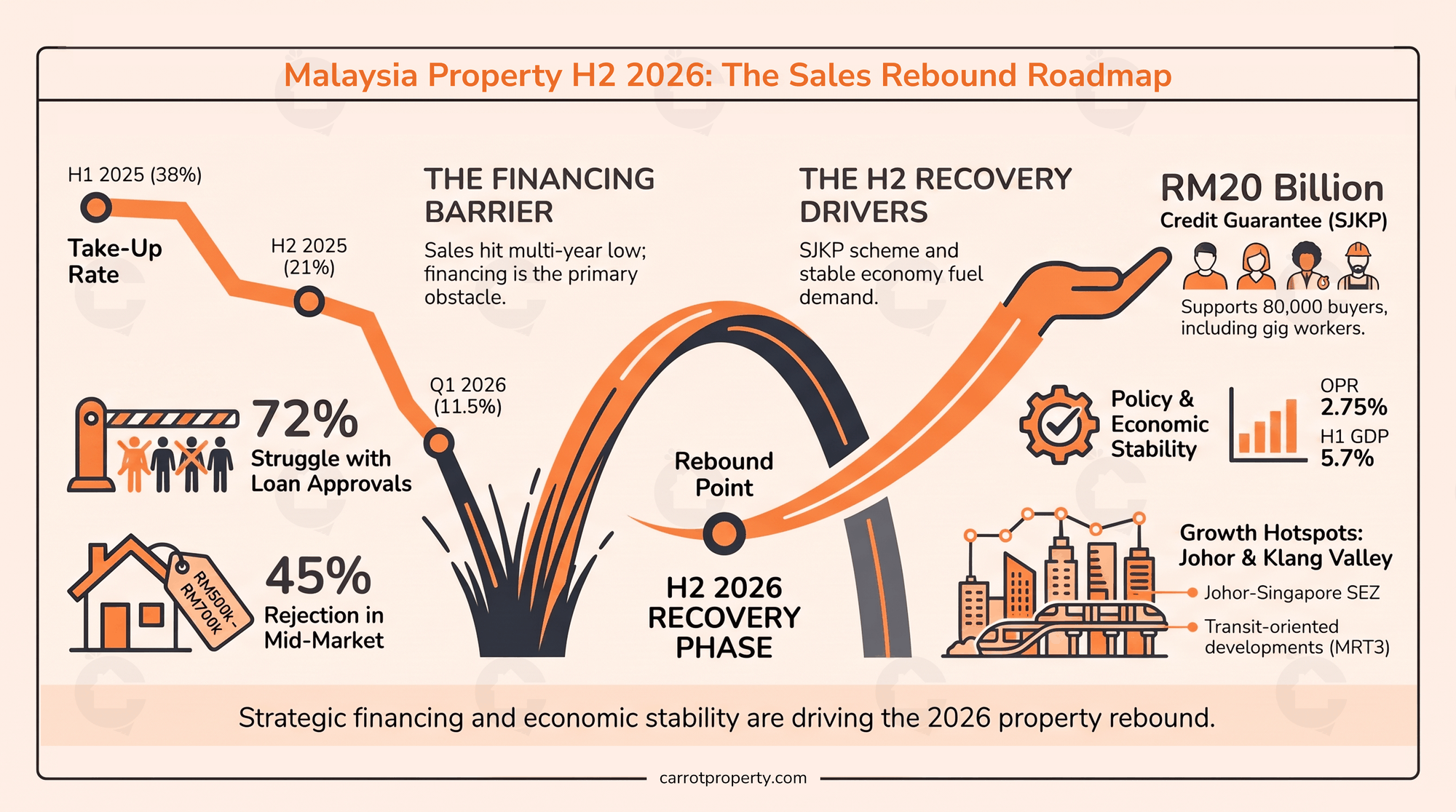
Two things have shifted since the weak start to 2026: Bank Negara has now held the Overnight Policy Rate (OPR) at 2.75% for a fifth consecutive meeting as of 3 September 2026, and the economy grew 5.7% in H1 2026 — both signals of a stable backdrop rather than a market under stress. Developers with large landbanks, including UEM Sunrise in Johor and Glomac in Klang Valley and Selangor, are pushing ahead with new phases rather than pulling back, and industry estimates put 60,000 to 80,000 new residential units entering planning or launch stages across Malaysia in 2026.
None of that guarantees a rebound on its own. What it does mean is that the conditions that would normally stall a recovery — rate hikes, a growth scare, developers sitting on unsold land — aren't currently the story. The actual constraint has been financing approval, which is a narrower and more fixable problem than a genuine demand collapse.
The Numbers: From 38% Take-Up to 11.5% — and Back
The clearest way to see the slowdown — and why "rebound" is a meaningful word rather than marketing spin — is to look at new launch take-up rates over the last four reporting periods. Take-up rate is simply units sold divided by units launched in that period; a healthy market typically runs somewhere north of 30%.
| Period | Units Launched | Units Sold | Take-Up Rate |
|---|---|---|---|
| H1 2025 | — | — | 38% |
| H2 2025 | 17,971 | 3,784 | 21% |
| Q1 2026 | 9,112 | 1,052 | 11.5% |
| H2 2026 (projected) | Higher launch volume expected | — | Rebound expected, not yet confirmed |
That's a real, sustained decline — not a single bad quarter. REHDA's Property Industry Survey, covering 166 developers across Peninsular Malaysia, found take-up nearly halved from H1 2025 to H2 2025, then roughly halved again by Q1 2026. The "rebound" being discussed for H2 2026 is developers and analysts expecting that trend to reverse as launch volumes pick up and financing conditions ease slightly — not a claim that it's already happened.
Why Developers Are Ramping Up Launches Now
Big landbank developers are the ones setting the pace for H2 2026. UEM Sunrise continues to lean on its sizeable Johor holdings, positioned to benefit from Johor-Singapore Special Economic Zone momentum — see our full breakdown in Data Centre Boom & Johor-Singapore SEZ. Glomac is actively expanding its Klang Valley and Selangor landbank, and CPI Land has signalled plans to acquire further sites in both Johor and Klang Valley. Analysts describe this as a market where "big landbank developers reign supreme" — smaller developers with thinner pipelines are the ones most exposed if the rebound doesn't fully materialise.
Part of the logic here is simply timing: developers who held back launches during the weak Q1 2026 stretch now have a backlog of projects ready to go, and a market that's stable on rates and growth is as good a window as any to release them.
The Financing Gap Behind the Slowdown
The single biggest reason cited for weak take-up isn't price and isn't lack of interest — it's financing. In REHDA's survey, 72% of developers pointed to buyers being unable to secure mortgage approval as the main obstacle to closing sales. The pain is concentrated in a specific price band: homes priced between RM500,001 and RM700,000 saw 31% to 45% of attempted transactions fail to get loan approval — precisely the band most first-time buyers and upgraders sit in. We covered the mechanics of this in Why Malaysian Banks Are Rejecting More Home Loans in 2026: tighter DSR calculations, CCRIS and CTOS checks, and banks pricing in more caution even with OPR steady.
This matters for the rebound story because it means the fix isn't really about developer confidence or even overall demand — it's about whether buyers who want to purchase can actually get the loan to do it.
The RM20 Billion Housing Credit Guarantee Scheme
This is the policy lever most directly aimed at the financing gap. Budget 2026 doubled the Housing Credit Guarantee Scheme (Skim Jaminan Kredit Perumahan, SJKP) allocation to RM20 billion, extending coverage to an estimated 80,000 first-time homebuyers — particularly gig workers, freelancers, hawkers, and other Malaysians with irregular or undocumented income who typically struggle to clear conventional bank underwriting. The scheme guarantees financing of up to 110% of the property price for homes up to RM500,000 under standard SJKP, and up to 120% for homes up to RM300,000 under SJKP MADANI, with the extra margin covering costs like MRTA, legal fees, and valuation. A separate RM1 billion allocation specifically supports contract-of-service workers, including contract teachers and KEMAS staff.
In theory, this directly targets the exact failure point REHDA's survey identified. In practice, it will take a few reporting cycles to see how much of the 80,000-buyer capacity actually converts into completed purchases versus buyers who still can't clear other underwriting checks (income stability, existing debt, credit history) that the guarantee doesn't fix on its own.
Where the Rebound Is Strongest
- 1Transit-oriented developments and mature townshipsMid-market homes priced RM500,000–RM1 million are becoming increasingly location-driven as supply expands — projects near transit and established amenities are proving the most resilient. See our MRT3 Circle Line guide for how transit access is shaping Klang Valley pricing.
- 2Klang Valley high-end residentialSupported less by financing-dependent local buyers and more by foreign investors and MM2H participants, who are less exposed to the DSR/CCRIS bottleneck affecting the mass market.
- 3Johor, on the back of JS-SEZ and data centre investmentLandbank-heavy developers are prioritising this corridor, and relocating professionals are adding genuine rental and purchase demand independent of the domestic financing story.
What Could Still Derail It
The optimism has real limits. Malaysia's property overhang — unsold completed units — stood above 32,000 units heading into 2026, and a rebound in new launches doesn't automatically clear existing unsold stock; see our Property Overhang 2026 guide for the fuller picture. If developers over-launch into a market that's still financing-constrained at the buyer level, it risks adding to overhang rather than working through it.
The other open question is how much of the RM20 billion credit guarantee capacity actually gets used before the end of 2026. If uptake is slow — whether due to awareness, bank processing capacity, or buyers still failing other underwriting checks — the financing gap that's been suppressing take-up won't close as quickly as the scheme's headline numbers suggest.
FAQs
Is the Malaysia property market actually rebounding in H2 2026?
Developers and analysts expect a rebound based on rising launch volumes, a stable OPR at 2.75%, and policy support like the RM20 billion Housing Credit Guarantee Scheme. As of September 2026, confirmed take-up data for H2 2026 sales isn't out yet — the rebound is a forecast backed by real conditions, not yet a confirmed result.
Why did take-up rates fall so much in late 2025 and early 2026?
Primarily financing, not price or demand. REHDA found 72% of developers cited buyers being unable to secure mortgage approval as the main obstacle, with the RM500,001–RM700,000 band hit hardest (31–45% loan rejection on attempted transactions).
What is the Housing Credit Guarantee Scheme (SJKP)?
A government-backed scheme, doubled to RM20 billion under Budget 2026, that guarantees home financing for buyers — particularly gig workers, freelancers, and those with irregular income — who typically struggle with conventional bank underwriting. It covers up to 110%–120% of the property price depending on the tier, and is expected to help around 80,000 first-time buyers.
Did Bank Negara cut the OPR to support the property market?
No. As of the 3 September 2026 meeting, Bank Negara has held the OPR steady at 2.75% for a fifth consecutive time, citing continued price stability and resilient growth (5.7% in H1 2026). Stability, not a rate cut, is what's supporting the current outlook.
Which areas are seeing the strongest rebound signs?
Transit-oriented and mature-township mid-market homes (RM500,000–RM1 million), Klang Valley high-end residential supported by foreign and MM2H buyers, and Johor on the back of JS-SEZ and data centre investment.
Should I buy now expecting prices to rise with the rebound?
REHDA still expects prices to rise only modestly nationally (around 1–2%) in 2026, and the overhang of more than 32,000 unsold units means the rebound isn't uniform across all areas or price bands. A stronger H2 doesn't mean every listing is a good buy — the fundamentals still vary a lot by location and price tier.
This article is for general guidance only and does not constitute legal or financial advice. Figures referenced are drawn from publicly reported REHDA, Bank Negara, and government sources current as of September 2026 and are subject to change as new reporting periods are released. Always verify current figures and financing eligibility directly with a licensed agent or financial institution before making a purchase decision.
Let's find out if this rebound actually applies to what you want to buy
Carrot Property can walk you through which areas and price bands are genuinely moving right now, and what financing options — including the SJKP scheme — might actually apply to you. No hard sell, just straight answers.
- Verified Klang Valley listings
- Honest pricing, no hard sell
- Straight answers on financing options