In This Guide
Scroll through new launch listings in Klang Valley right now and you'll spot the phrase everywhere: "steps from future MRT3 station." It's become the new "5 minutes to KLCC" — a line meant to make you feel like you're getting in early on something big. Sometimes that's fair. Sometimes the nearest confirmed station is still an interim name on a map that MRT Corp itself says could change.
MRT3 — officially the Circle Line — cleared a genuine milestone in mid-2025 and land acquisition is now underway, so it's no longer just a rumour. But "real project" and "buy now because prices will jump" are two different claims, and conflating them is exactly how buyers end up overpaying for a station that's still years from breaking ground. Here's what MRT3 actually is, what the timeline really looks like, and how to think about the property angle without getting caught up in the marketing.
What Is the MRT3 Circle Line?
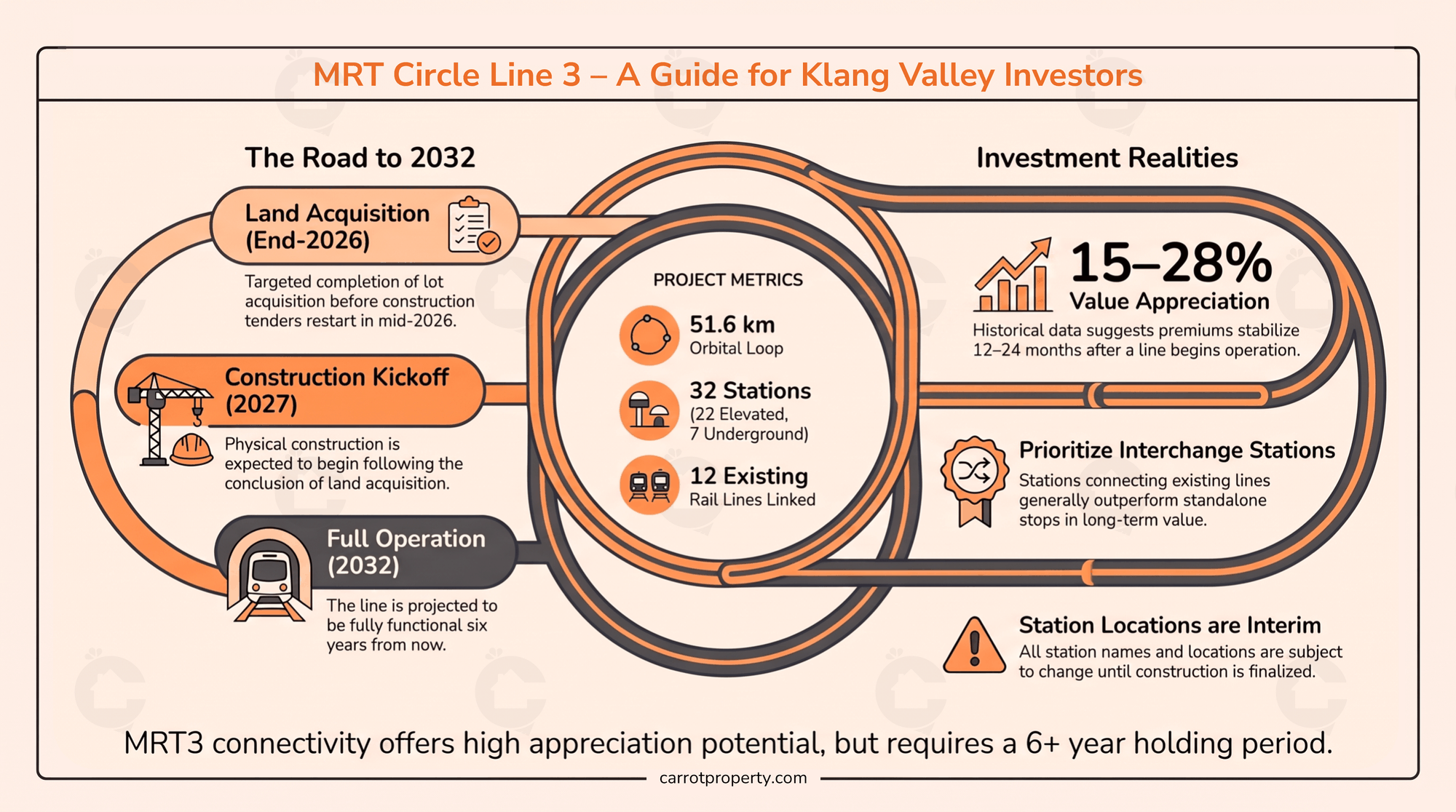
MRT3 is the third and final line planned for the Klang Valley MRT network — and unlike MRT1 (Sungai Buloh–Kajang) and MRT2 (Putrajaya Line), which run point-to-point through the city centre, MRT3 is designed as a full 51.6km orbital loop around KL's fringes. Its entire purpose is to connect the radial lines that already exist — MRT1, MRT2, the LRT lines, KTM, and the KL Monorail — rather than adding another route into the centre.
According to MRT Corp, the operator behind the project, the Circle Line will link up with 12 existing rail lines through 10 interchange and connecting stations, is designed to carry up to 25,000 passengers per hour per direction, and a full loop journey is expected to take around 73 minutes. For areas that currently require a car or a bus transfer to reach any rail line at all, that's a meaningfully different proposition than for areas already sitting on an existing MRT or LRT stop.
Route, Stations, and Interchange Points
Per MRT Corp's own published alignment, the Circle Line will have 32 stations (22 elevated, 7 underground), excluding 3 provisional stations and 2 depots. The current interim list runs through three broad stretches:
- Northwest: Bukit Kiara Selatan, Bukit Kiara (provisional), Sri Hartamas, Bukit Segambut, Taman Sri Sinar, Dutamas, Kompleks Duta
- North to East: Titiwangsa, Kampung Puah (provisional), Jalan Langkawi, Danau Kota, Setapak, Rejang, Setiawangsa, AU2 (provisional), Taman Hillview, Tasik Ampang, Kampung Pandan, Pandan Indah, Taman Kencana, Taman Cheras, Taman Midah
- South to Southwest: Jalan Yaacob Latif, Sri Permaisuri, Salak Selatan, Salak Jaya, Kuchai, Jalan Klang Lama, Pantai Dalam, Pantai Permai, Universiti, UM
Notably for buyers already familiar with the Old Klang Road corridor, the Jalan Klang Lama and Kuchai stations sit right in the area we've covered before in our OUG Property Guide 2026 — worth a read if you're specifically weighing that pocket rather than the Circle Line as a whole.
Project Timeline: Where Things Actually Stand
This is the part that gets glossed over in marketing copy, so here's the direct version, based on MRT Corp's own July 2025 announcement:
- 1Final Railway Scheme approved — July 2025Transport Minister Anthony Loke signed off on the alignment, following a public inspection period where MRT Corp says 93.3% of the 45,000 respondents supported the project.
- 2Land acquisition — targeted for completion by end of 2026The number of lots required was reduced from 1,012 to 690 through alignment refinements, which should ease (but not eliminate) acquisition friction.
- 3Construction tenders — expected to restart around mid-2026Industry research (MBSB Research) points to a re-tender exercise picking back up mid-2026, with contract awards likely toward the end of the land acquisition period.
- 4Physical construction — expected to begin in 2027Not 2026. Several earlier reports suggested an earlier start; the confirmed position from MRT Corp and industry trackers now points to 2027.
- 5Full operation — targeted for 2032That's roughly six years from now. Megaproject timelines in Malaysia have shifted before, so treat this as directional rather than locked in.
Do MRT Stations Really Move Property Prices?
Historical precedent gives a reasonable — though not guaranteed — answer. Properties within 500m of new MRT1 (Sungai Buloh–Kajang Line) stations reportedly appreciated by roughly 15–28% in the 24 months following that line's 2017 opening, based on industry analysis from property research desks. Early commentary on MRT3 from the same type of sources points to a similar 15–22% premium range for well-positioned stations, with some citing up to 30% in currently underserved pockets that gain rail access for the first time.
Two caveats matter more than the headline numbers:
- Premiums show up late, not early. The pattern from MRT1 and LRT3 suggests price effects stabilise 12–24 months after a line is operationally running — not at groundbreaking, and not at the announcement stage we're at now with MRT3.
- Interchange stations tend to outperform ordinary stations. A station that connects to an existing MRT, LRT, or KTM line carries both new-rider convenience and transfer traffic — generally a stronger draw than a standalone stop further from the existing network.
Treat any specific percentage you see quoted — including the ones above — as directional analyst estimates rather than a promised return. No one can guarantee what MRT3 does to a specific unit's resale value six-plus years before the line even opens.
Areas Along MRT3 Worth Watching
Rather than picking one "best" MRT3 area, it's more useful to understand the different types of opportunity along the loop:
- Sri Hartamas / Dutamas / Kompleks Duta (northwest): Already an established, higher-price pocket — MRT3 here is more about improving connectivity for an area that's largely built out than about unlocking new growth.
- Setapak / Danau Kota / Titiwangsa (north-central): A denser, more affordable corridor that currently leans on the Ampang Line and buses — a new interchange-adjacent line here has more room to move the needle on accessibility.
- Pandan Indah / Taman Cheras / Salak Selatan (east/southeast): Mixed established and developing pockets, with Salak Selatan already an interchange point for KTM and the Kajang Line — worth checking which of these becomes another true interchange under MRT3.
- Kuchai / Jalan Klang Lama / Pantai Dalam / Universiti (south/southwest): Overlaps with the Old Klang Road corridor already gaining attention — see our OUG Property Guide 2026 for the deeper dive on that specific pocket.
As we noted in our look at Malaysia's property overhang numbers, a rail announcement alone doesn't guarantee demand keeps pace with new supply — several of these corridors could see a wave of new launches all marketed on the same MRT3 story. More competing stock in the same pocket can cap near-term price growth even where the underlying transit story is genuinely good.
The Risk of Buying Too Early on a "Future MRT" Promise
None of this means MRT3 isn't worth factoring into a buying decision — it just means the risks deserve equal airtime to the upside:
- Station names and locations are still interim. MRT Corp says so directly. A unit marketed as "5 minutes from [Station]" could end up further away, or the station could shift, before construction locks it in.
- Six-plus years is a long time to hold for a catalyst. If your investment thesis depends heavily on MRT3, you're underwriting a multi-year wait before any price effect is likely to show up at all.
- Developers price in the story early. New launches near confirmed alignments often already carry a premium at launch, well before the line exists — meaning some of the expected upside may already be baked into today's asking price.
- Megaprojects can slip. Land acquisition, funding, and contractor timelines have moved before on Malaysian rail projects. A 2032 target should be treated as a planning estimate, not a guarantee.
- Oversupply risk compounds in "hot" corridors. When multiple developers chase the same MRT3 narrative in the same stretch, rental and resale competition can offset some of the transit-driven gain.
How to Evaluate an MRT3-Adjacent Property
If you're specifically weighing a property because of its MRT3 proximity, a few checks are worth doing before you commit:
- Confirm whether the nearest station is one of the 10 interchange/connecting stations or a standalone stop — interchange stations generally carry the stronger long-term case.
- Check the actual walking distance, not just the marketing claim, and factor in that the alignment could still shift during the land acquisition phase.
- Weigh how much of the "MRT3 premium" is already priced into the asking price versus genuinely still to come.
- Evaluate the property on its current fundamentals too — existing amenities, school catchment, rental demand — so it still makes sense even if MRT3 slips further.
- Separate the developer's track record from the MRT3 story; a strong transit narrative doesn't offset a weak or unproven developer.
FAQs
When will MRT3 be completed?
MRT Corp's current target is full operation by 2032, with land acquisition targeted for completion by end-2026 and construction expected to begin in 2027. These are planning targets and could shift, as has happened with earlier phases of this project.
Which areas will benefit most from MRT3?
Areas without existing rail access that gain an interchange station — such as parts of the Setapak/Danau Kota and Kuchai/Jalan Klang Lama corridors — are generally expected to see a larger relative connectivity improvement than areas that already sit on an existing MRT or LRT line.
Should I buy property now purely because it's near a future MRT3 station?
Be cautious about treating MRT3 alone as the investment thesis. Station locations are still interim, construction hasn't started, and historical premiums tend to show up only after a line is operationally stable — years from now for MRT3. Buy on the property's current fundamentals, and treat MRT3 as a bonus, not the whole case.
Is MRT3 different from MRT1 and MRT2?
Yes. MRT1 (Sungai Buloh–Kajang) and MRT2 (Putrajaya Line) are radial lines running through the city centre. MRT3 is an orbital loop around the fringes of KL, designed specifically to connect the existing radial lines and other rail modes to each other via interchange stations.
Do property prices really go up because of new MRT stations?
Historical data from MRT1's 2017 opening suggests properties within 500m of new stations saw meaningful appreciation in the following two years, and industry commentary expects a similar pattern for MRT3. But this isn't guaranteed for every station, and effects generally show up well after the line opens rather than at announcement.
Are the MRT3 station locations and names final?
No. MRT Corp explicitly states that all current station names are interim and subject to change as land acquisition and detailed design progress. Confirm the latest alignment directly from MRT Corp before treating any station location as fixed.
This article is for general guidance only and does not constitute legal or financial advice. Rail alignments, station names, and project timelines are subject to change by the relevant authorities — always verify current details with MRT Corp and a qualified property professional before making a purchase decision based on MRT3.
Let's look at the fundamentals, not just the transit story
Carrot Property can walk you through which listings genuinely stack up on their own merits — with or without MRT3 in the picture.
- Verified Klang Valley listings
- Honest pricing, no hard sell
- Straight answers on transit-linked risk