In This Guide
- Low Rates, Falling Approvals: The 2026 Paradox
- Debt Service Ratio (DSR): The Real Gatekeeper
- Worked Example: How Much Loan Can You Actually Get?
- CCRIS vs CTOS: What Banks Actually See
- The Numbers: How Bad Is Approval in 2026?
- Why the RM500,000–RM700,000 Band Gets Hit Hardest
- New Car Loan Rules (June 2026): A Quiet Way to Free Up DSR
- Self-Employed or Gig Worker? The SJKP Guarantee Scheme
- Step-by-Step: Before You Apply
- FAQs
"Loan tak lepas" — the loan didn't go through — is a phrase that comes up a lot in Malaysian property conversations in 2026, and not just from buyers who obviously overextended themselves. Steady civil servants, established professionals, even people who assumed their salary was more than comfortable are getting rejected. What makes it confusing is that interest rates haven't gone up — if anything, borrowing is cheaper than it's been in years. So why does getting approved feel harder than ever? Here's what's actually driving the rejections, and what you can do about it before you fall for a unit you can't finance.
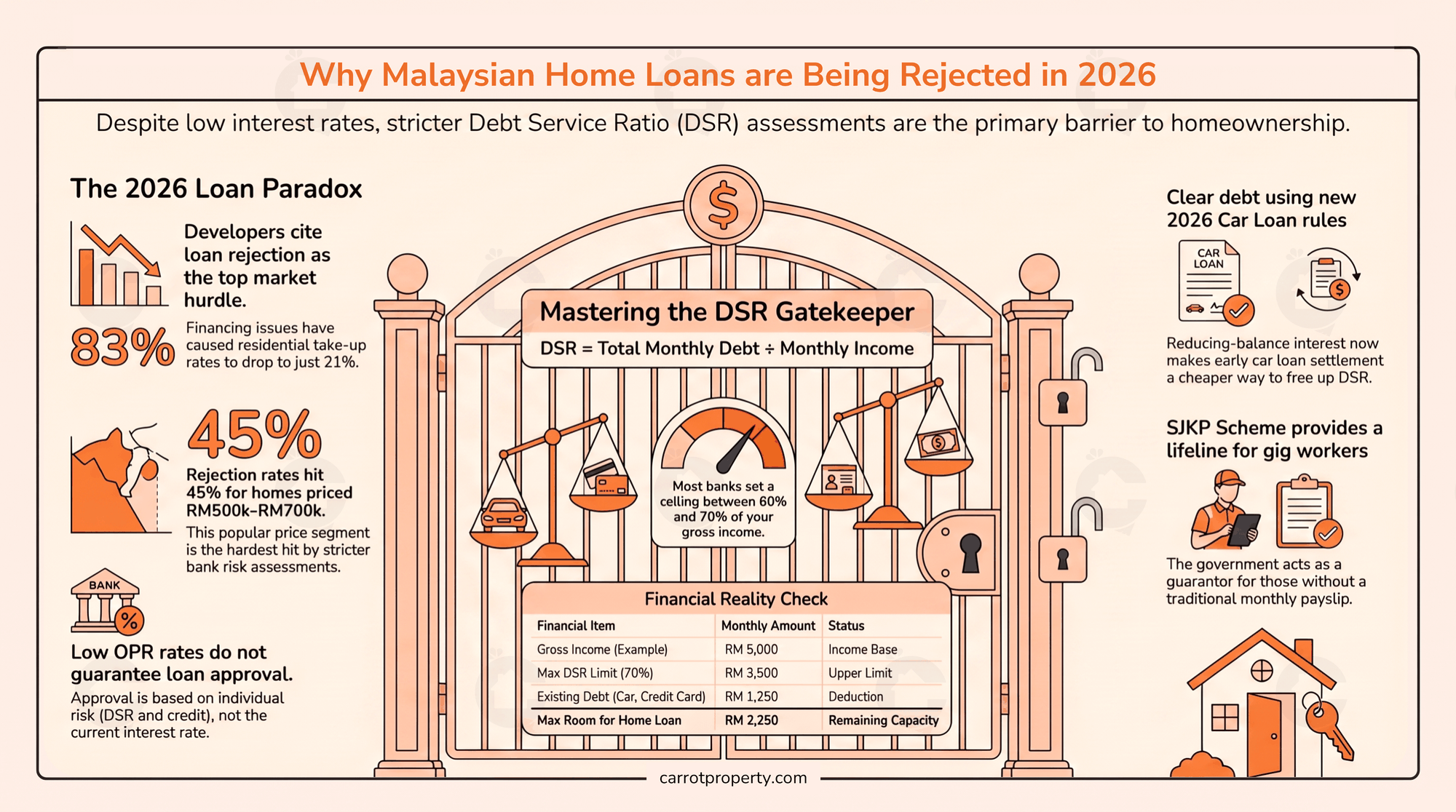
Low Rates, Falling Approvals: The 2026 Paradox
Bank Negara Malaysia has held the Overnight Policy Rate (OPR) at 2.75% since its July 2025 cut, and inflation stayed low at around 1.6% in the first quarter of 2026. On paper, that's a good environment to borrow in — monthly instalments on an approved loan are about as cheap as they've been in years.
But a lower OPR only changes what you pay after you're approved. It does nothing to change how a bank decides whether to approve you in the first place. Bank Negara has itself pushed back on the idea that financing access alone explains why homes aren't selling — its position is that the real gatekeeper is each bank's own risk assessment: your debt service ratio, your credit record, and how stable your income looks on paper. None of that improves just because the OPR drops.
Debt Service Ratio (DSR): The Real Gatekeeper
DSR is the single biggest reason loan applications get rejected in Malaysia, and it's simpler than it sounds: it's the percentage of your monthly income that's already committed to debt repayments, including the new home loan instalment you're applying for.
DSR = Total Monthly Debt Commitments ÷ Monthly Income × 100%
"Commitments" is a wider net than most first-time buyers expect. It includes your car loan, PTPTN, personal loans, and credit card minimum payments — and increasingly, buy-now-pay-later (BNPL) instalments and other digital financing platforms, which banks are now factoring into risk assessments more aggressively than before.
There's no single DSR limit that applies across every bank in Malaysia. Most set their ceiling somewhere between 60% and 70% of gross income, though some banks stretch this to 80–90% for higher-income earners with strong repayment histories. The catch: the more your existing commitments eat into that ceiling, the smaller the home loan you'll qualify for — regardless of how attractive your salary looks on paper.
Worked Example: How Much Loan Can You Actually Get?
Say you earn RM5,000 a month, and your bank applies a 70% DSR ceiling — a fairly typical figure. That gives you a maximum of RM3,500 a month across all debt commitments, including your new home loan instalment.
Now suppose you're already paying RM800 for a car loan, RM300 in credit card minimums, and RM150 towards PTPTN — RM1,250 in existing commitments. That leaves roughly RM2,250 a month of DSR "room" for a home loan instalment.
| Item | Monthly Amount |
|---|---|
| Gross monthly income | RM5,000 |
| Maximum DSR (70%) | RM3,500 |
| Existing commitments (car loan, credit card, PTPTN) | RM1,250 |
| Remaining room for home loan instalment | RM2,250 |
At a typical reference rate of around 4.0% p.a. over a 35-year tenure, RM2,250 a month works out to roughly a RM500,000 loan — assuming no other commitments creep in before your application. Push your existing commitments up by even a few hundred ringgit, and that ceiling drops fast. This is exactly why two people earning the same salary can walk away with very different loan offers.
CCRIS vs CTOS: What Banks Actually See
Alongside DSR, your credit record is the other pillar banks lean on — and many buyers only find out what's in theirs after a rejection.
CCRIS
CCRIS (Central Credit Reference Information System) is maintained by Bank Negara Malaysia itself and pulls your repayment history over the past 12 months from every participating bank and financial institution. It shows outstanding balances, payment conduct, and any special-attention accounts — essentially a factual ledger of how you've handled debt recently.
CTOS
CTOS is a private credit reporting agency that goes further, compiling a broader profile and a numerical score (300–850) that factors in repayment consistency and behavioural trends over time, not just a 12-month snapshot.
Even small, easily-forgotten missteps — a late credit card payment, an unpaid BNPL instalment — can leave a mark. One missed payment usually won't sink an application on its own, but a pattern of them will. Pull both reports before you apply, not after you're rejected.
The Numbers: How Bad Is Approval in 2026?
This isn't just a vague feeling among buyers — developers are seeing it directly in their sales numbers. The Real Estate and Housing Developers' Association Malaysia (Rehda), in its Property Industry Survey covering 166 developers across Peninsular Malaysia, found that developers launched 17,971 residential units in the second half of 2025 — but only 3,784 were sold. That's a take-up rate of just 21%, down sharply from 38% in the first half of the year.
Crucially, this isn't a demand problem. 72% of developers surveyed said financing issues were the main obstacle, and 83% of them pointed specifically to housing loan rejections as the challenge — not pricing, not a lack of buyer interest. Deals are dying at the end-financing stage: buyers want the homes, sign the SPA, and then can't secure the loan needed to complete the purchase.
Why the RM500,000–RM700,000 Band Gets Hit Hardest
According to the same Rehda survey, rejection rates in the RM500,001–RM700,000 price band ranged between 31% and 45% — noticeably higher than other price segments. That band matters because it's exactly where most first-time buyers and upgraders are shopping, and it's precisely the loan size our worked example above lands on for a RM5,000 earner with a handful of existing commitments.
Put differently: a huge slice of Malaysia's active buyer pool sits right in the price range where financing is hardest to secure — which is why loan rejections are showing up as a market-wide slowdown rather than an isolated problem for a few unlucky applicants.
The Maple Residences @ Taman OUG
Priced around RM643,000, this Carrot Property listing sits squarely inside the RM500,000–RM700,000 band flagged by Rehda's survey as the hardest-hit for loan rejections — a good example of why sorting out your DSR before you shop matters here more than in most other price ranges.
View The Maple Residences →New Car Loan Rules (June 2026): A Quiet Way to Free Up DSR
One overlooked lever for improving your DSR took effect on 1 June 2026: the Hire Purchase (Amendment) Act 2026. It abolishes the old flat-rate and Rule of 78 interest methods for car loans and hire-purchase financing, replacing them with an Effective Interest Rate (EIR) and reducing-balance calculation instead.
In practical terms, this makes settling a car loan early — or refinancing it — meaningfully cheaper than it used to be, since interest is now calculated only on the remaining principal rather than a fixed schedule set at the start of the loan. If your car loan is a big chunk of your existing commitments, as in our RM800/month example above, paying it down early is now a more realistic way to free up DSR room before you apply for a mortgage than it was under the old rules.
Self-Employed or Gig Worker? The SJKP Guarantee Scheme
If you're a freelancer, commission-based agent, or gig worker without a fixed monthly payslip, you're likely to face extra scrutiny — banks still lean toward applicants with stable, provable income, and fluctuating earnings make DSR and documentation harder to assess cleanly.
What many self-employed buyers don't realise: the Skim Jaminan Kredit Perumahan (SJKP), or Housing Credit Guarantee Scheme, lets the government act as guarantor on your behalf, reducing the bank's risk and improving your approval odds even without a traditional payslip. The scheme has already helped over 93,000 households secure home financing, through 17 participating banks.
If your income doesn't fit neatly into a standard payslip format, ask your bank directly whether you qualify for SJKP before assuming you're stuck — it's easy to miss if you're only comparing listed interest rates.
Step-by-Step: Before You Apply
- 1Calculate your real DSRAdd up every existing commitment — car loan, PTPTN, credit cards, BNPL — against your gross income, honestly, before you start unit-hunting.
- 2Pull your CCRIS and CTOS reportsCheck for errors, outstanding balances, or late payments you didn't know about, and fix what you can before applying.
- 3Reduce commitments where possibleSettle or pay down high-interest debt first — under the new reducing-balance rules, early car loan settlement is cheaper than before.
- 4Get an Approval-in-PrincipleAsk a bank for a pre-assessment based on your real numbers before you commit to a unit or sign a booking form.
- 5Check SJKP eligibility if self-employedDon't assume automatic rejection just because you lack a fixed payslip.
- 6Shop within your approved ceilingEspecially in the RM500,000–RM700,000 band, where rejection rates are highest — not your hoped-for price.
- 7Keep documentation clean and completeIncomplete or inconsistent paperwork is one of the most avoidable reasons for rejection.
If your numbers do work out, don't forget to check whether you qualify for the first-time buyer stamp duty exemption on homes up to RM500,000, extended to 2027 — it lowers your upfront cost, though it won't change your DSR or credit assessment.
FAQs
What DSR do Malaysian banks usually require for a home loan?
Most banks cap DSR somewhere between 60% and 70% of gross income, though some extend this to 80–90% for higher earners with strong credit profiles. There's no single fixed rule — it varies by bank and applicant.
Why would someone with a good salary still get rejected?
A high salary doesn't offset a high DSR. If your existing commitments already eat up a large share of your income, banks will see you as high risk regardless of how much you earn — this is exactly the pattern Rehda's 2026 survey found among developers' buyers.
Does a lower OPR make it easier to get approved?
No. A lower OPR reduces your monthly instalment on an already-approved loan, but it doesn't change how strict a bank's DSR, CCRIS, or CTOS assessment is. Approval is about risk, not rate.
Can self-employed or gig workers still get a home loan in Malaysia?
Yes — banks generally require stronger supporting documents (tax filings, consistent bank statements, business registration), and the SJKP guarantee scheme specifically helps buyers without a fixed payslip improve their approval odds.
Will the new car loan rules help my chances?
They can. Since 1 June 2026, car loan interest is calculated on a reducing balance rather than a flat rate, making early settlement more worthwhile than before — freeing up DSR room if a car loan is a significant chunk of your existing commitments.
Does the stamp duty exemption help if my loan application gets rejected?
Not directly. The first-time buyer stamp duty exemption (extended to 2027) lowers your upfront cost, but it has no bearing on your DSR or credit assessment. See our stamp duty exemption guide for how the two pieces fit together.
This article is for general guidance only and does not constitute legal or financial advice. DSR limits, interest rates, and loan approval criteria vary by bank and individual profile, and figures cited from third-party surveys are subject to revision as newer reporting periods are published — always verify your own numbers with a bank or licensed financial adviser before making a purchase decision.
Know your numbers before you shop for a home
Carrot Property can point you to units that fit a realistic loan ceiling — not just a wish-list price — so financing doesn't derail your purchase.
- Verified Klang Valley listings
- Honest pricing, no hard sell
- Straight answers on what you can afford