In This Guide
- What's Actually Happening in Johor Right Now
- Inside the Johor-Singapore Special Economic Zone
- The Data Centre Engine Behind the Numbers
- What This Means for Property Prices
- The RTS Link: The Connectivity Multiplier
- The Risks: Water, Power, and Buying on a Promise
- Who Should Actually Be Paying Attention
- FAQs
For years, Johor was the punchline of Malaysian property investing — the state everyone said was "about to take off," usually right before it didn't. That narrative has genuinely shifted in 2026. Johor is now the top state in the country for approved investment, and the reason isn't tourism or another mega-mall — it's data centres, semiconductors, and a formal economic zone signed jointly with Singapore that's already changing how relocating professionals and regional investors think about property south of the Causeway.
This isn't a "buy now before it's too late" piece. It's a look at what's actually been approved and built so far, what's still just a plan, and where the real risks sit for anyone considering property in Johor on the back of this story.
What's Actually Happening in Johor Right Now
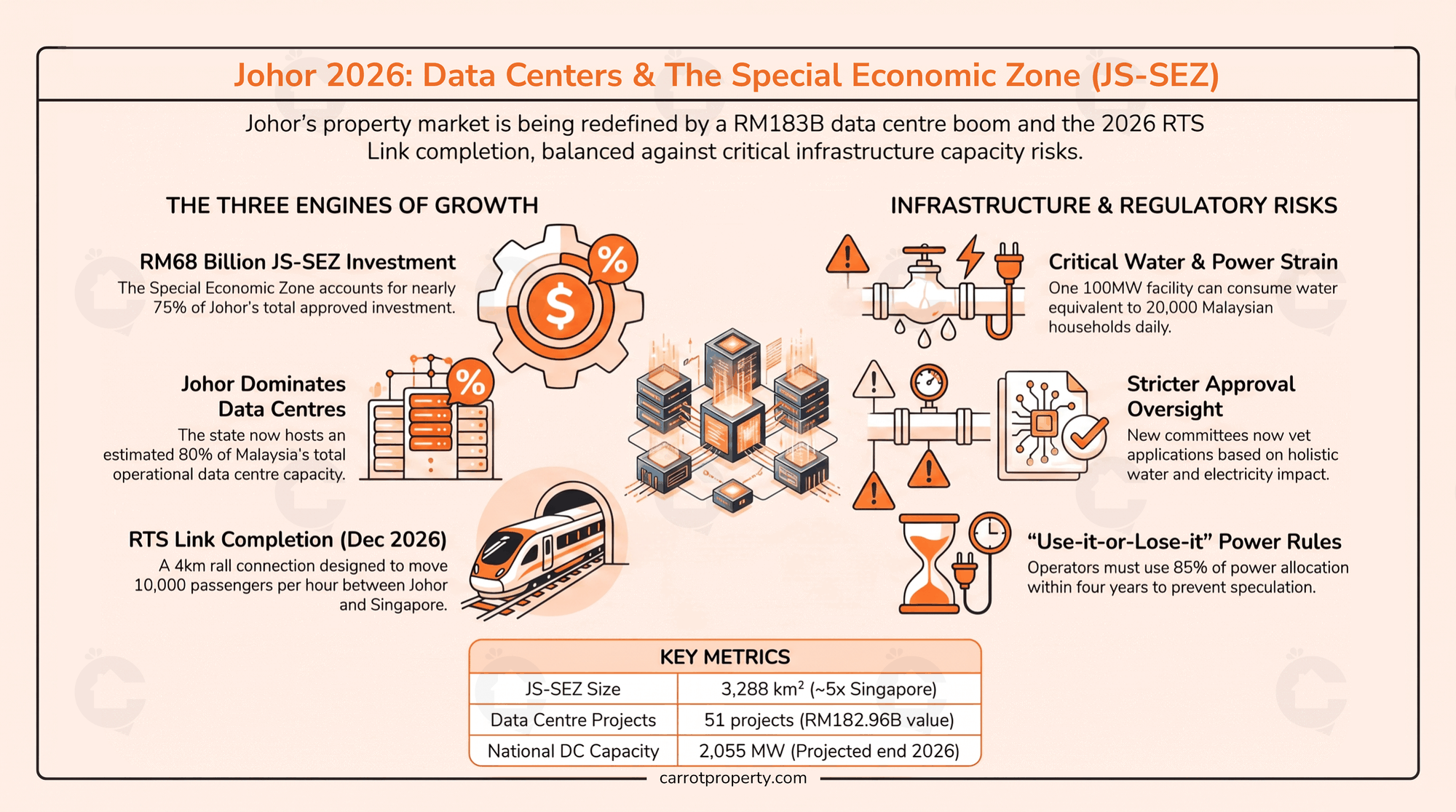
In the first nine months of 2025, Johor became Malaysia's top-performing state for approved investment, pulling in roughly RM91.1 billion. Of that, the Johor-Singapore Special Economic Zone (JS-SEZ) alone accounted for about RM68 billion — nearly three-quarters of the state's total. That's a genuinely different scale of capital commitment than Johor has seen in prior "growth corridor" cycles like Iskandar Malaysia's earlier phases.
The immediate property-market effect has been most visible in two places: industrial land, where data centre and manufacturing demand has pushed prices up sharply, and mid-to-high-end residential stock near Johor Bahru's CBD, Iskandar Puteri, and Medini, where relocating managerial and technical staff — including teams shifting operations from Singapore — are driving rental and purchase demand.
Inside the Johor-Singapore Special Economic Zone
The JS-SEZ was formally established through an agreement signed by Malaysia and Singapore on 8 January 2025. It covers 3,288 km² — an area described as almost five times the size of Singapore — spanning nine flagship zones across Iskandar Malaysia and the Pengerang petrochemical hub. It's a joint economic initiative, not a Johor-only project, which is part of why it's attracted a different calibre of institutional investor than previous state-level incentive schemes.
Qualifying investors can access a 5% corporate tax rate for up to 15 years, and eligible knowledge workers can qualify for a 15% personal income tax rate for up to 10 years — incentives clearly designed to draw the kind of high-value, long-stay professionals who also happen to be exactly the tenant and buyer profile that moves a residential market.
The Data Centre Engine Behind the Numbers
Data centres are the single most visible driver of Johor's current investment wave. By late 2025, the state had approved 51 data centre projects representing roughly RM182.96 billion in committed investment — a figure that reflects total project value over the projects' build-out, not a single year of spend. Nationally, Malaysia approved around RM144.4 billion across 143 data centre projects between 2021 and June 2025, which gives a sense of just how disproportionately concentrated this activity has become in Johor specifically.
Malaysia's total data centre capacity is projected to more than double to roughly 2,055 MW by the end of 2026, and Johor now holds an estimated 80% of the country's operational data centre capacity — making it, by a wide margin, the epicentre of this build-out rather than one hub among several.
One angle worth watching that gets less attention than the headline numbers: as factories, hyperscale facilities, and logistics operations expand around Pengerang and Pasir Gudang, a secondary wave of supporting commercial demand tends to follow — banking branches, F&B outlets, printing and packaging suppliers, and other small commercial-titled units that serve the industrial workforce rather than end consumers. It's a slower, less headline-grabbing property story than the residential angle, but a real one.
What This Means for Property Prices
The clearest price effect so far has been in industrial land. Johor's median industrial land price climbed roughly 67% over four years, from about RM85 psf in 2020 to around RM142 psf more recently, according to industry land-transaction tracking. Separately, average industrial land prices in Johor were reported at roughly RM86 psf in 2025, up about 8.4% year-on-year — a different dataset and time slice than the four-year figure above, so treat the two as directionally consistent (industrial land is getting materially more expensive) rather than as the same number restated.
On the residential side, the demand pattern is narrower than "all of Johor is booming." It's concentrated in mid-to-high-end condominiums and serviced apartments close to Johor Bahru's CBD, Iskandar Puteri, and Medini — the areas relocating managerial staff, technical personnel, and Singapore-based operations teams actually want to live in, largely for the commute and lifestyle amenities those precincts offer. Mass-market residential stock further from these precincts hasn't shown the same clear demand signal yet.
| Metric | Figure | Period / Source Context |
|---|---|---|
| JS-SEZ size | 3,288 km² (~5x Singapore) | Since agreement signed 8 Jan 2025 |
| Johor approved investment | ~RM91.1 billion | First 9 months of 2025 |
| JS-SEZ share of that investment | ~RM68 billion (74.6%) | Same period |
| Johor data centre investment | ~RM182.96 billion across 51 projects | Cumulative, approved by late 2025 |
| National DC capacity (est.) | ~2,055 MW | Projected by end of 2026 |
| Johor's share of national DC capacity | ~80% | Current estimate |
| RTS Link completion | December 2026 (targeted) | Cross-border rail, JB–Woodlands North |
The RTS Link: The Connectivity Multiplier
Running alongside the investment story is a piece of physical infrastructure that could meaningfully change day-to-day life for cross-border workers: the Johor Bahru–Singapore Rapid Transit System (RTS) Link, targeted for completion in December 2026. It's a short 4km cross-border rail connection between JB Sentral and Singapore's Woodlands North, designed to cut what can currently be a painfully congested land-border crossing down to a matter of minutes, with capacity for up to 10,000 passengers per hour in each direction.
For property, the RTS Link matters less as a standalone catalyst and more as a multiplier on everything else happening in Johor. It directly supports the JS-SEZ's knowledge-worker thesis — commuting into Singapore for work while living in a lower-cost Johor Bahru or Iskandar Puteri becomes genuinely practical rather than aspirational once the crossing takes minutes instead of an unpredictable hour-plus in traffic.
The Risks: Water, Power, and Buying on a Promise
The data centre and SEZ story is real, but it isn't risk-free, and the risks aren't the usual "will the market crash" kind — they're infrastructure-capacity risks that are already playing out on the ground.
Data centres are extremely water- and power-hungry. A typical 100-megawatt facility can consume around 4.2 million litres of water a day — roughly equivalent to the daily domestic water use of 18,000 to 20,000 Malaysian households. By November 2025, Johor authorities had already asked some investors to postpone water-cooled facility expansions by roughly 18 months (to around mid-2027) amid drought conditions, and halted new approvals for the largest, highest water-use (Tier 1 and Tier 2) facilities. By February 2026, unease had escalated into visible community pushback, with residents in Nusa Bayu staging a protest over transparency around data centre plans and their potential impact on local water and power supply.
Johor's regulators have responded with real oversight rather than ignoring the problem — a Special Technical Committee now vets data centre applications holistically for water and electricity impact, and operators are required to use at least 85% of their declared power allocation within their first four years, which discourages speculative over-applications that never get built out. That's a reasonable sign of a state managing growth rather than one that's lost control of it, but it also confirms the capacity strain is genuine, not just activist noise.
Who Should Actually Be Paying Attention
- 1Rental yield investorsMid-to-high-end condos and serviced apartments near JB CBD, Iskandar Puteri, and Medini are seeing genuine demand from relocating professionals — the clearest near-term opportunity in this story.
- 2Longer-horizon capital appreciation investorsAreas closer to the Eastern Gate flagship zone (Pengerang, Pasir Gudang) carry more industrial-linked upside, but also more execution and infrastructure-capacity risk before that upside is proven.
- 3Commercial-titled unit buyersThe secondary wave of banking, F&B, and supplier demand around industrial clusters is a slower-burn opportunity worth watching rather than acting on immediately — see our guide on commercial vs residential property investment in Malaysia for how to weigh that trade-off.
- 4Buyers chasing the RTS Link specificallyWorth comparing this transit-driven thesis against how we assessed a similar situation for MRT3 in Klang Valley — infrastructure upside is real, but timelines shift, and paying full future-value pricing today carries real risk if delivery slips.
FAQs
What is the Johor-Singapore Special Economic Zone (JS-SEZ)?
A jointly agreed economic zone between Malaysia and Singapore, signed 8 January 2025, spanning 3,288 km² across nine flagship areas including Iskandar Malaysia and Pengerang. It offers tax incentives — a 5% corporate tax rate for up to 15 years and a 15% personal tax rate for eligible knowledge workers for up to 10 years — to attract investment and skilled talent.
Is the data centre boom the same thing as the JS-SEZ?
No. The JS-SEZ is the broader economic and tax framework; the data centre boom is one major industry cluster within it, concentrated mainly around Pengerang and Pasir Gudang. Other parts of the SEZ focus on advanced manufacturing, aerospace, and other sectors.
When will the RTS Link be ready?
It's currently targeted for completion in December 2026. As with any large infrastructure project, treat that date as directional — verify the latest status before making a purchase decision that depends on it.
What are the biggest risks with Johor property right now?
The two most concrete risks are water and power capacity strain from the data centre build-out (which has already led regulators to delay some approvals) and the general risk of paying a premium for property based on infrastructure or economic-zone benefits that haven't fully materialised yet. Verify delivery timelines rather than taking marketing claims at face value.
Which parts of Johor are seeing the most residential demand?
Mid-to-high-end condominiums and serviced apartments near Johor Bahru's CBD, Iskandar Puteri, and Medini are currently seeing the clearest demand, largely from relocating managerial and technical staff, including teams shifting operations from Singapore.
Should I buy commercial or residential property to ride this trend?
It depends on your time horizon and risk appetite. Residential near the CBD precincts is the more immediate, demand-backed opportunity. Commercial-titled units serving the industrial clusters are a slower, longer-horizon bet. See our Commercial vs Residential Property Investment in Malaysia 2026 guide for a fuller breakdown of that decision.
This article is for general guidance only and does not constitute legal or financial advice. Investment and infrastructure figures referenced are drawn from publicly reported government and industry sources current as of September 2026 and are subject to change — megaproject timelines in particular should be treated as directional, not fixed. Always verify current figures, project status, and pricing directly with official sources or a licensed agent before making a purchase decision.
Let's separate the real opportunity from the hype
Carrot Property can walk you through what's actually driving demand right now, which precincts have the clearest fundamentals, and what to verify before you commit — no hard sell, just straight answers.
- Verified Klang Valley listings
- Honest pricing, no hard sell
- Straight answers on emerging growth areas