In This Guide
- Why Everyone's Asking "What Changed" in 2026
- What Actually Changed vs What Stayed the Same
- Who's Eligible for Akaun Sejahtera Buy House Withdrawal
- How Much You Can Actually Withdraw
- Worked Example: Calculating Your Withdrawal
- How to Apply: Step-by-Step
- Limits, Risks & What to Watch Out For
- Withdraw Now for a Bigger Down Payment — Or Leave It for Retirement?
- FAQs
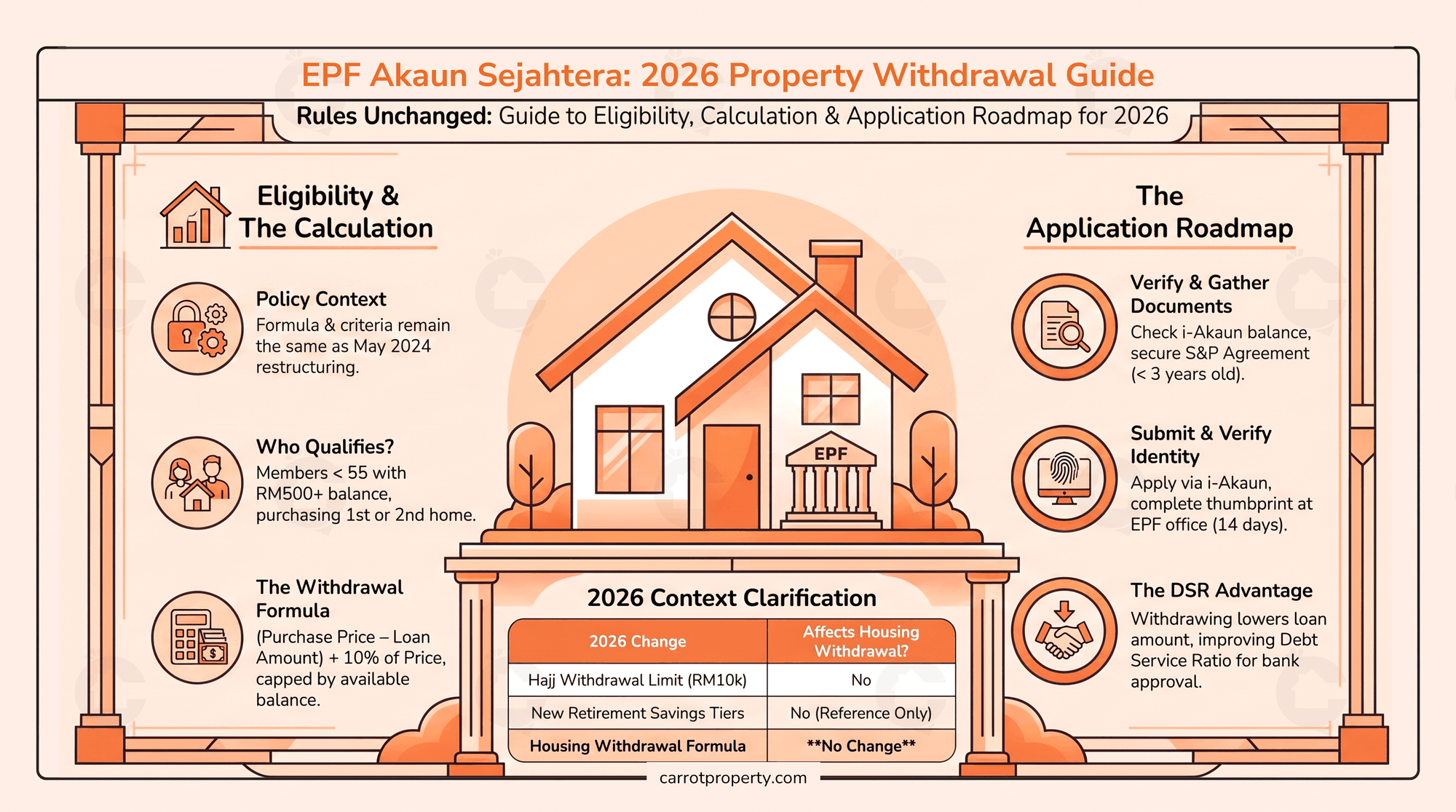
"Eh, EPF Account 2 boleh withdraw for house or not ah, I heard the rules changed already" — some version of this has probably come up at your dinner table or in a family WhatsApp group sometime in 2026. Between the account restructuring a few years back, EPF's own January 2026 policy announcements, and Budget 2026 headlines about housing, it's an easy thing to get confused about. Some buyers are holding off on a purchase because they're not sure they still qualify. Others are about to apply for the wrong amount because they're working off outdated information. Let's clear it up properly — what actually changed, what didn't, and what it means for your next property purchase.
Why Everyone's Asking "What Changed" in 2026
Part of the confusion has a real root cause. On 11 May 2024, EPF restructured its two-account system into three: Akaun Persaraan (75% of contributions, locked for retirement), Akaun Sejahtera (15%, for mid-term needs like housing, education, and healthcare), and the new Akaun Fleksibel (10%, withdrawable anytime). What used to be called "Account 2" — the account everyone associated with house down payments — was renamed Akaun Sejahtera, and its share of new contributions dropped from 30% to 15%.
That renaming is old news by now, but plenty of members still think and speak in "Account 2" terms, which makes every fresh round of EPF news feel like it might be another rule change to the house-withdrawal facility specifically. Then, on 1 January 2026, EPF rolled out a fresh set of policy enhancements, and Budget 2026 (announced 10 October 2025) added more housing-related measures on top. Put those together and it's no wonder people assume something about buying a house with EPF savings has shifted too.
What Actually Changed vs What Stayed the Same
Here's the honest answer: the Buy House Withdrawal formula and eligibility rules under Akaun Sejahtera have not changed since the 2024 restructuring. What changed on 1 January 2026 sits mostly around Akaun Sejahtera, not inside the house-withdrawal facility itself — and Budget 2026's housing measures are separate government incentives, not EPF withdrawal rules.
| 2026 Change | Affects Buy House Withdrawal? |
|---|---|
| Hajj withdrawal limit raised from RM3,000 to RM10,000 (from Akaun Sejahtera), with simplified application | No — separate Akaun Sejahtera facility |
| Retirement Income Adequacy (RIA) Framework takes effect: Basic (RM390,000), Adequate (RM650,000), Enhanced (RM1.3 million) savings tiers | No direct rule change, but a useful benchmark for your withdraw-or-wait decision |
| Withdrawal threshold for savings above RM1 million raised gradually, starting at RM1.1 million in 2026 | No — only relevant to members near or above the Enhanced Savings tier |
| i-Saraan Plus (e-hailing/p-hailing drivers), i-Suri eligibility extended to age 60, i-Simpan/i-Topup renaming | No — voluntary contribution schemes |
| First-time buyer stamp duty exemption (homes ≤RM500,000) extended to 31 December 2027 | Indirect — lowers total cash needed to complete a purchase, doesn't change EPF's formula |
| Housing Credit Guarantee Scheme (SJKP) guarantee doubled to RM20 billion | Indirect — helps loan approval odds for gig/self-employed buyers, separate from EPF |
| Buy House Withdrawal formula & eligibility | Unchanged since May 2024 |
Who's Eligible for Akaun Sejahtera Buy House Withdrawal
Straight from EPF's own criteria, you qualify if you meet all of the following:
- Malaysian or non-Malaysian EPF member
- Below 55 years of age at the time of application
- Minimum balance of RM500 in Akaun Sejahtera
- Purchasing a residential property — bungalow, terrace, semi-detached, apartment, condominium, studio apartment, service apartment, townhouse, SOHO, or a shop lot with a residential unit, from a developer in Malaysia
- Financing via an approved loan from a recognised lender (bank, government financing institution, employer, licensed cooperative, or approved insurer) OR self-financed (cash purchase)
- Have never made a housing withdrawal before, or have made one previously but have since sold or disposed of that property
EPF allows Buy House Withdrawal for up to two residential properties in a lifetime. If you've already used Akaun Sejahtera savings for your first home, you must sell or dispose of it — with documented proof — before you can apply again for a second. Your Sale and Purchase Agreement (or Proclamation of Sale from a court/administrator) also can't be more than three years old at the time you apply.
How Much You Can Actually Withdraw
The eligible amount depends on how you're financing the purchase:
| Financing Type | Eligible Withdrawal |
|---|---|
| Housing loan (individual) | Difference between purchase price and approved loan amount + 10% of purchase price, OR entire Akaun Sejahtera balance — whichever is lower |
| Self-financing / cash purchase (individual) | Purchase price + additional 10%, OR entire Akaun Sejahtera balance — whichever is lower |
| Joint withdrawal (loan or self-financed) | Same formula, but capped by the applicant's own Akaun Sejahtera balance, not a combined household total |
In every case, EPF pays out whichever figure is lower — the formula amount, or what you actually have sitting in Akaun Sejahtera.
Worked Example: Calculating Your Withdrawal
Say you're buying an apartment for RM450,000, with a 90% margin of finance approved — a loan of RM405,000.
| Item | Amount |
|---|---|
| Purchase price | RM450,000 |
| Approved loan (90%) | RM405,000 |
| Difference (price − loan) | RM45,000 |
| + 10% of purchase price | RM45,000 |
| Eligible withdrawal (or entire Akaun Sejahtera balance, if lower) | RM90,000 |
If your Akaun Sejahtera balance is only RM60,000, that's what you'd actually receive — capped at whichever figure is lower, and always leaving the required RM500 minimum behind. Buying with cash instead of a loan? Swap the formula: it's the purchase price plus an additional 10%, again capped by your balance.
How to Apply: Step-by-Step
- 1Check your Akaun Sejahtera balanceLog into the KWSP i-Akaun app or web portal to confirm what's actually available.
- 2Gather proof of purchaseYour Sale and Purchase Agreement, or Proclamation of Sale from an administrator/court, dated within the last 3 years.
- 3Gather proof of financingHousing loan approval letter for financed purchases, or a lawyer's confirmation letter plus a receipt for at least 20% of the price for self-financed ones.
- 4Submit Form KWSP 9C (AHL)Apply online via i-Akaun, or manually by visiting or mailing an EPF office. SOHO purchases must be applied for manually at the counter.
- 5Complete thumbprint verification (CIJ)Required within 14 working days at any EPF office or Self-Service Terminal — miss this window and the application is rejected.
- 6Track your applicationCheck status and payment through the i-Akaun app, web portal, or at any EPF office.
- 7Receive paymentCredited directly if you hold an account with an EPF panel bank; otherwise a Banker's Cheque is issued.
Limits, Risks & What to Watch Out For
- Two-property lifetime cap. There's no Akaun Sejahtera withdrawal for a third home under any circumstances.
- You must fully dispose of your first home first. A second-home withdrawal requires documented proof — a title transfer, deed of assignment, or similar — that the first property has been sold or transferred.
- It's a shared pool. Akaun Sejahtera also covers education, healthcare, and Hajj withdrawals. If you've already dipped into it for other needs, there's less left for a house — and since only 15% of new contributions flow in (versus 30% under the old Account 2 structure), it rebuilds more slowly than it used to.
- Not for renovation, personal use, or overseas property. The facility is strictly for purchasing or building a residential home in Malaysia.
- Non-Malaysians are eligible too, under the same criteria — though overseas payments are limited to Brunei Dollar or Singapore Dollar demand drafts, or a foreign telegraphic transfer for other currencies.
Withdraw Now for a Bigger Down Payment — Or Leave It for Retirement?
Assuming you're eligible, the real question for most buyers isn't "can I withdraw" — it's "should I withdraw the full amount." There's a genuine trade-off here, and it's worth thinking through rather than defaulting to the maximum.
The case for withdrawing: a bigger down payment means a smaller loan, which directly improves your Debt Service Ratio (DSR) — the single biggest reason home loan applications get rejected in Malaysia right now. For more on how DSR actually works, see our guide to why banks are rejecting more home loans in 2026.
The Maple Residences @ Taman OUG
Priced around RM643,000, this Carrot Property listing is a good example of where a meaningful Akaun Sejahtera top-up on the down payment could be the difference between a DSR that clears your bank's ceiling and one that doesn't.
View The Maple Residences →The case for leaving it: Akaun Sejahtera savings earn EPF's annual dividend, which compounds over time and is factored into the RIA Framework's savings tiers — Basic (RM390,000), Adequate (RM650,000), and Enhanced (RM1.3 million). If a large withdrawal drops your total EPF savings meaningfully below the Basic tier for your age, you're trading a chunk of long-term retirement compounding for a shorter-term affordability win. And because only 15% of new contributions now replenish Akaun Sejahtera, rebuilding that balance after a big withdrawal takes longer than it did before 2024.
There's no universal right answer — it depends on your age, how many years you have until 55, how tight your DSR is without the withdrawal, and how comfortable you are with a smaller retirement cushion in exchange for owning sooner. This isn't financial advice; if the numbers are close, it's worth running them past a licensed financial adviser before deciding.
FAQs
Did EPF change the Akaun Sejahtera house withdrawal rules in 2026?
No. The Buy House Withdrawal formula and eligibility criteria have been unchanged since the May 2024 account restructuring. EPF's 2026 policy changes affect Hajj withdrawal limits, the Retirement Income Adequacy Framework, and voluntary contribution schemes — not the house withdrawal facility itself.
How much can I withdraw from Akaun Sejahtera to buy a house?
For a financed purchase: the difference between the purchase price and your approved loan, plus 10% of the purchase price, or your entire Akaun Sejahtera balance — whichever is lower. For a self-financed purchase: the purchase price plus an additional 10%, or your entire balance, whichever is lower.
Can I withdraw from Akaun Sejahtera for a second property?
Yes, up to a lifetime maximum of two residential properties — but you must sell or dispose of the first one, with documented proof, before applying for the second.
Can non-Malaysians use Akaun Sejahtera to buy a house?
Yes, the eligibility criteria apply equally to Malaysians and non-Malaysians. Overseas payments are made via Brunei Dollar or Singapore Dollar demand draft, or a foreign telegraphic transfer for other currencies.
Will withdrawing from Akaun Sejahtera affect my retirement savings?
Yes — it reduces the balance earning EPF dividends and moves you further from the RIA Framework's savings tiers (Basic RM390,000, Adequate RM650,000, Enhanced RM1.3 million). Since Akaun Sejahtera now only receives 15% of new contributions, a large withdrawal takes longer to rebuild than it did under the old Account 2 structure.
Can I use Akaun Sejahtera to pay my monthly home loan instalments instead of a down payment?
Yes — EPF's separate Housing Loan Monthly Instalment Withdrawal lets you draw from Akaun Sejahtera to cover loan instalments for a minimum of six months, or until you're back on financial track. Instalment payments must be scheduled to end before you turn 55.
This article is for general guidance only and does not constitute legal or financial advice. EPF withdrawal rules, formulas, and government incentives are subject to change — always verify your eligible amount via the official KWSP i-Akaun app or an EPF office, and consult a licensed financial adviser before making a withdrawal decision.
Work out your real numbers before you commit
Carrot Property can help you find a unit that fits your actual EPF-assisted budget — not just a wish-list price — so your down payment and your DSR line up from the start.
- Verified Klang Valley listings
- Honest pricing, no hard sell
- Straight answers on what you can afford