In This Guide
- Is the Urban Renewal Act Even Law Yet?
- What the Bill Actually Covers
- The 80% Consent Threshold, Explained
- No, It's Not a Forced "En-Bloc Sale" — Not Anymore
- What Compensation Are You Actually Promised?
- Worked Example: What 80% Means for a 100-Unit Building
- Who Should Actually Be Watching This Closely
- What To Do If You Own — or Are Buying — an Older Property
- FAQs
You've probably seen the headline version by now: "government can force redevelopment with 80% owner consent." It sounds alarming, and depending on which Facebook group you saw it in, it's either framed as the state seizing your house or as the only realistic fix for Malaysia's stock of crumbling, decades-old flats that nobody can legally touch. Both framings are doing a lot of work to sound simple. The actual Bill is messier, still unfinished, and has already changed twice since it was first tabled.
This isn't a take on whether the Urban Renewal Bill is good or bad policy. It's a plain breakdown of what's actually written into it as of the most recent confirmed reporting, what's still just a proposal that could change again, and what it practically means if you own — or are thinking of buying — an older strata unit, landed house, or shoplot in Malaysia.
Is the Urban Renewal Act Even Law Yet?
No — and this is the single most misunderstood part of the whole story. Despite almost everyone (including us, in this article's title, because that's how people actually search for it) calling it "the Urban Renewal Act," it is currently still the Urban Renewal Bill 2025 — draft legislation that has not passed Parliament.
Here's the timeline as it's actually played out: Housing and Local Government Minister Nga Kor Ming tabled the Bill for its first reading in the Dewan Rakyat on 21 August 2025. A second reading was originally pencilled in for just days later, but it was pushed back after both government and opposition MPs publicly called for the Bill to be sent to a Parliamentary Select Committee for closer scrutiny — a rare moment of cross-bench agreement that something in the draft needed more work. By late 2025, the government confirmed it was withdrawing the Bill entirely for what officials described as "comprehensive enhancements," incorporating feedback gathered during the debate. As of the most recent confirmed reporting in January 2026, the Ministry said it was ready to re-table the Bill for second reading pending Cabinet approval, with further consultation sessions planned alongside residents, academics, elected representatives, and industry players.
What the Bill Actually Covers
The stated aim of the Urban Renewal Bill is to give the government a legal framework to redevelop, regenerate, and revitalise buildings that are aged, under-utilised, or dilapidated — tackling urban decay in areas where redevelopment has stalled for decades. The scope is wider than most people assume. It isn't limited to crumbling low-cost flats:
- Strata-titled buildings — condos, apartments, and flats, particularly those flagged as old or structurally deteriorating
- Landed residential homes — including freehold houses, if they sit within an area designated as an urban renewal zone
- Shoplots and commercial premises — again, freehold status doesn't automatically exclude a property
Coverage generally centres on properties more than around 30 years old sitting in areas the government designates "aged, under-utilised, or dilapidated." That designation step matters — a property doesn't fall under the Bill just by being old; the area has to be formally flagged first, which is also one of the process details still being refined.
The 80% Consent Threshold, Explained
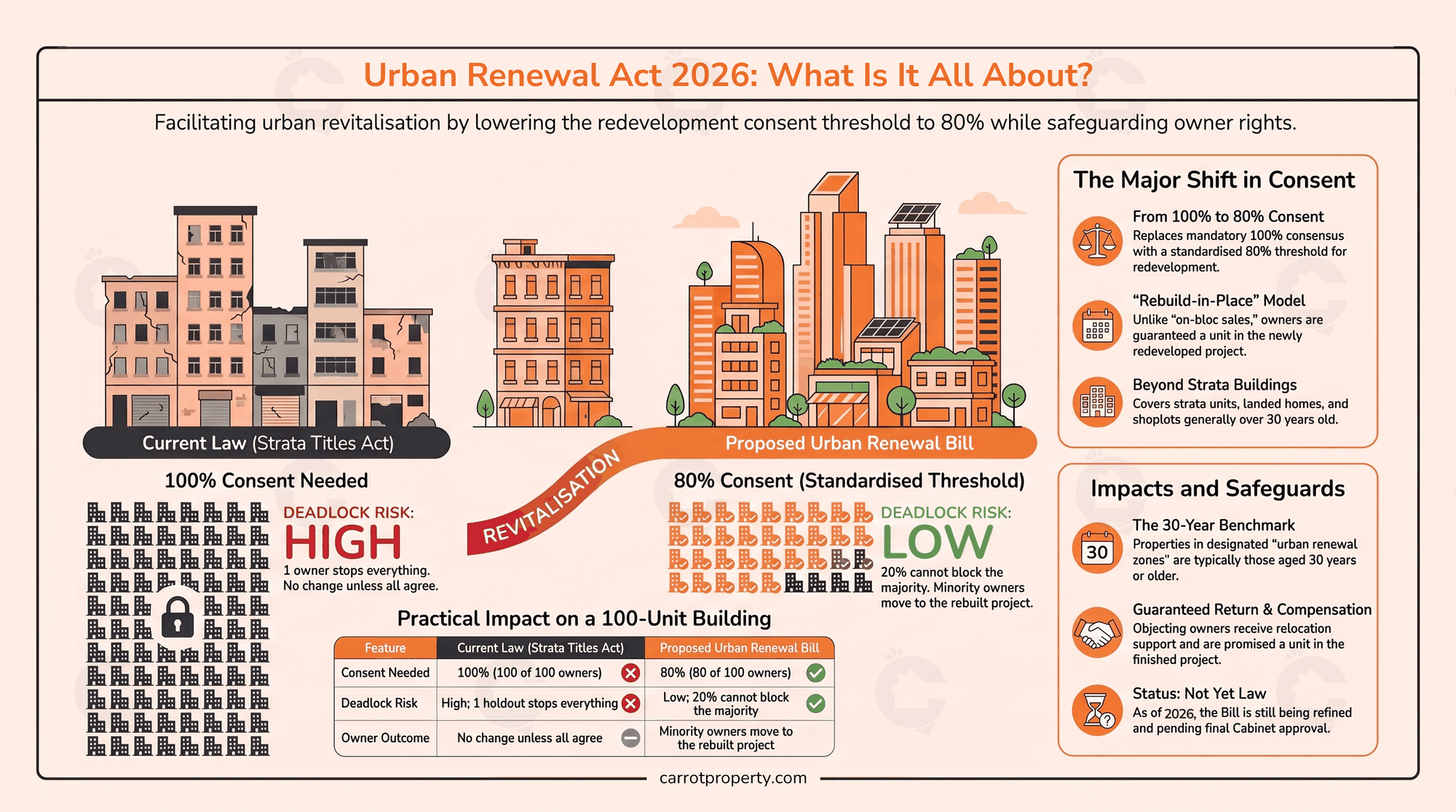
Here's the actual mechanism causing the alarm. Under the existing Strata Titles Act 1985 (Section 57), terminating a strata title to redevelop a building requires 100% agreement from every single owner. In practice, this has meant that a single holdout — one unit owner, out of possibly hundreds — can block redevelopment of an entire building indefinitely, even one that's structurally unsafe. This is the real, well-documented deadlock the Bill is trying to solve.
Following recommendations from the Parliamentary Select Committee on Infrastructure, Transport and Communications in August 2025, the government revised its proposal to a standardised 80% consent threshold across all urban renewal projects, regardless of the building's age or condition (earlier drafts had suggested the threshold could scale with a building's age — the government simplified it to a flat 80%). In plain terms: instead of needing every owner on board, a project could proceed once 80 out of 100 owners agree, with the remaining 20% brought into the project regardless of their individual objection.
That's the part critics — including consumer groups, opposition MPs, and some legal commentators — have pushed back on hardest: it removes a veto that current law gives every individual owner, and raises a genuine constitutional question about property rights that hasn't been fully settled in the public debate yet.
No, It's Not a Forced "En-Bloc Sale" — Not Anymore
Some of the loudest early criticism assumed the Bill would work like an "en-bloc sale" — the whole building sold off to a single developer, with every resident, including objectors, forced to relocate elsewhere and take a cash payout. That model does exist in places like Singapore, and it's genuinely what a lot of the earliest fear around this Bill was about.
The government has since said it will not adopt that en-bloc-sale-and-relocate model for urban renewal projects, specifically to avoid forced relocation and the gentrification risk that comes with it. The stated approach instead is: secure 80% consent to begin consultations, then guarantee that owners can return to live in the same redeveloped building or area once construction is complete — rebuild-in-place rather than sell-and-scatter.
What Compensation Are You Actually Promised?
The Bill includes provisions for a clearer land acquisition and compensation process for affected owners and tenants, plus the creation of an Urban Renewal Fund intended to help finance these projects — including, in principle, temporary relocation arrangements while redevelopment is underway.
Where the draft is currently thinner: as written, it does not yet explicitly guarantee that compensation will be pegged to market value, and it doesn't spell out a transparent, standardised valuation mechanism. That gap is one of the more substantive criticisms raised by legal commentators — the concern isn't that compensation is absent from the Bill, it's that "fair compensation" hasn't yet been defined precisely enough to prevent owners receiving less than their unit is actually worth. Mitigation measures floated so far include independent valuation, a mediation process, and an appeal route for owners who disagree with the compensation offered — but the fine detail of how these would work in practice is part of what the ongoing "comprehensive enhancements" are meant to address.
Worked Example: What 80% Means for a 100-Unit Building
To make the mechanism concrete, here's an illustrative (not real) scenario showing the practical difference between the current law and the Bill's proposed threshold:
| Scenario | Under Current Law (Strata Titles Act, S.57) | Under the Proposed Urban Renewal Bill |
|---|---|---|
| 100-unit condo, built 1990, flagged as dilapidated | Needs 100 of 100 owners to agree — 1 holdout blocks the entire project | Needs 80 of 100 owners to agree — remaining 20 can be brought in |
| What happens to objecting owners | Building legally cannot be redeveloped while they refuse | Project can proceed; objecting owners are guaranteed a unit in the rebuilt project (per current government position) plus compensation/relocation support |
| Net effect | Redevelopment gridlock is common in practice | Redevelopment becomes possible, but minority owners lose their individual veto |
This is really the whole debate in one table. Malaysia does have a real, well-documented problem with old, unsafe buildings that can't be fixed because 100% agreement is nearly impossible to get once a building has more than a handful of owners. The Bill trades that deadlock for a different risk — reducing an individual owner's ability to say no. Which trade-off is "better" depends heavily on whether you're the one holding out, or the one stuck in a building nobody can legally repair.
Who Should Actually Be Watching This Closely
- 1Owners of pre-1996 strata unitsIf your condo or flat is approaching or past 30 years old, and especially if it's in a Klang Valley area with known maintenance or structural issues, this Bill is directly relevant to you — even if your building hasn't been formally designated yet.
- 2Owners of older landed homes and shoplots in aging townshipsFreehold status does not automatically exempt you. Older landed housing areas and legacy commercial strips are explicitly within scope if the area gets designated for renewal.
- 3Buyers considering an older subsale unit right nowThis doesn't mean avoid old buildings altogether — but it's now a genuine factor to price into any older purchase, alongside the usual maintenance-fund and structural checks.
- 4Investors and landlords with a portfolio of aging unitsWorth tracking which local authorities start designating urban renewal zones once the Bill (if passed) comes into force, since that's the trigger point, not just a building's age on its own.
What To Do If You Own — or Are Buying — an Older Property
If you already own an older unit, there's genuinely nothing actionable to do right now beyond staying informed — the Bill isn't law, thresholds and safeguards are still being negotiated, and no areas have been designated under it because it doesn't yet exist as an Act. Panic-selling ahead of legislation that hasn't passed, and whose final compensation terms aren't set, isn't a decision we'd encourage.
If you're actively house-hunting and this uncertainty is something you'd rather not factor into your decision at all, it's worth weighing newer freehold developments that are, by decades, nowhere near old enough to fall into any future urban renewal zone. Aras Residences @ WCity OUG is one example of a newer freehold project in an area we've covered in more depth in our OUG Property Guide 2026 — it sidesteps this specific question entirely, simply because of how new the development is.
If you do own something older and want a genuinely informed read on your specific situation — building age, area, strata condition — that's exactly the kind of conversation worth having with an agent who isn't trying to rush you into a decision either way.
FAQs
Is the Urban Renewal Act already law in Malaysia?
No. As of the most recent confirmed reporting, it remains the Urban Renewal Bill 2025 — tabled for first reading in August 2025, then withdrawn for revisions. The government has said it's ready to re-table it for a second reading, but it has not yet passed Parliament or come into force.
Does the 80% consent rule mean my neighbours can force me to sell my home?
Not exactly "sell" — the government has ruled out an en-bloc-sale-and-relocate model. The current position is that 80% owner consent can move a redevelopment project forward, with objecting owners guaranteed a unit in the rebuilt project rather than being forced out entirely. The detail of how compensation and valuation would work for owners who disagree is still one of the less finalised parts of the Bill.
Does this Bill affect freehold landed houses, or just old apartments?
It can affect both. The current draft's scope extends to landed residential homes and commercial shoplots — not just strata apartments — provided the property sits within an area formally designated as an urban renewal zone, generally for buildings around 30 years or older.
What compensation would I get if my building were redeveloped under this Bill?
The Bill provides for compensation and an Urban Renewal Fund to help finance projects, but as currently drafted it doesn't explicitly guarantee compensation pegged to market value or define a standardised valuation method. Independent valuation, mediation, and an appeal process have been proposed as safeguards, but the precise mechanics are still being worked out.
How would I know if my building or area is designated for urban renewal?
Designation hasn't started anywhere yet, because the Bill hasn't passed. Once (and if) it does, expect designations to be announced by the relevant local authority or KPKT — this is a step still to be defined in the finalised legislation.
Should I avoid buying an older property because of this Bill?
Not necessarily — but it's now a reasonable factor to weigh alongside the usual checks on an older unit (maintenance fund health, structural condition, strata management quality). If you'd rather remove the question altogether, a newer freehold development simply isn't old enough to be in scope for the foreseeable future.
This article is for general guidance only and does not constitute legal or financial advice. The Urban Renewal Bill 2025 is active, unpassed legislation that has already been amended once and may change further before (or if) it is passed into law — details in this article reflect the most recently confirmed public reporting as of September 2026 and are subject to change. Always verify the current status of the Bill with the Ministry of Housing and Local Government (KPKT) or a qualified lawyer before making any decision based on it.
Let's talk through what actually fits your situation
Whether you're sitting on an older unit or looking at newer freehold alternatives, Carrot Property can walk you through the real trade-offs — no pressure, no hard sell.
- Verified Klang Valley listings
- Honest pricing, no hard sell
- Straight answers on new vs. older property