In This Guide
- There's No Universal Answer — Here's Why
- The Real Price Gap Between New Launch and Subsale
- Why Financing Is Where the Two Paths Really Diverge
- Worked Example: Same RM520,000 Budget, Two Loan Outcomes
- Myth-Busting: "Can I Still Get DIBS?"
- Why Today's Unsold-Homes Numbers Actually Matter Here
- When a New Launch Makes More Sense
- When Subsale Makes More Sense
- What to Check Before You Commit, Either Way
- FAQs
Every property agent has an opinion on this, and it usually happens to match whatever they're currently selling. New launch agents will tell you subsale is "old and overpriced." Subsale agents will tell you new launches are "just glossy brochures and a 3-4 year wait." Both are half right, which is the most annoying kind of answer, but it's the honest one.
The real difference between new launch and subsale in Malaysia right now isn't really about which one is "better" — it's about which one your financing, your timeline, and your risk tolerance actually fit. This guide breaks down the price gap, the financing mechanics banks apply differently to each, and a worked example so the numbers are concrete instead of abstract.
There's No Universal Answer — Here's Why
Before the comparisons, one honest caveat: this decision genuinely depends on the specific project, the specific subsale unit, and your specific financial position. A new launch priced sensibly against its surrounding subsale market is a completely different proposition from one priced 30% above it on the promise of "future potential." This guide gives you the framework to tell the difference — not a blanket answer that one path always wins.
The Real Price Gap Between New Launch and Subsale
Take a mature, well-connected area as an example: a new launch condo there might be priced around RM750 psf in 2026, while a five-to-eight-year-old subsale unit in the same neighbourhood could transact at RM600–650 psf, depending on floor level and condition. That's a genuine 15–20% premium for "new" — sometimes justified by modern layouts and current building standards, sometimes just reflecting the developer's marketing budget baked into the price.
Developers close some of that gap with incentives: rebates, cashback, free legal fees, free MOT, or furnishing packages, often advertised as 5–10% off the headline Sale and Purchase Agreement (SPA) price. Here's the part that trips a lot of buyers up: the SPA price used for these rebates is often deliberately set higher to absorb the "discount" — so the effective net price you actually pay can look ordinary once the rebate is factored in, while the inflated SPA price still becomes your official purchase price of record. That inflated figure follows you later — it affects your Real Property Gains Tax (RPGT) base if you sell, and, as covered in the next section, it no longer works the way it used to for loan calculations either.
Why Financing Is Where the Two Paths Really Diverge
This is the part most comparisons skip, and it's arguably more important than the psf gap.
New launch: the net selling price rule
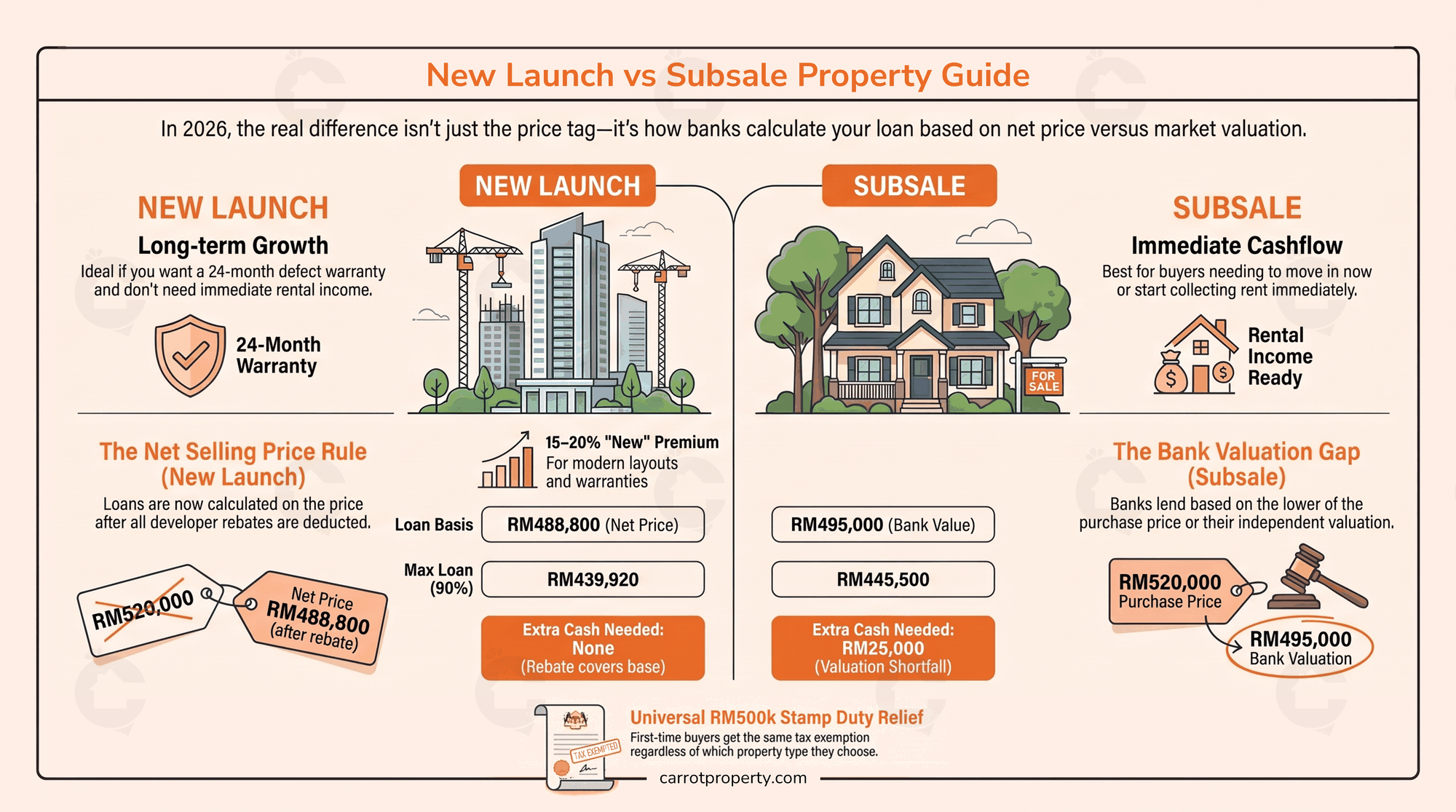
As of 2026, Bank Negara Malaysia requires your margin of finance (loan amount) to be calculated on the net selling price — the price after developer discounts, rebates, and incentives are deducted — not the inflated gross SPA price. If a developer offers an 8% rebate on a RM700,000 unit, your loan margin is calculated on RM644,000 (RM700,000 minus the RM56,000 rebate), not the original RM700,000. This closes a loophole that used to let inflated headline prices, paired with matching rebates, secure a higher effective loan than the net price would otherwise allow. Practically: don't assume the SPA price is what the bank will lend against — ask your loan agent to work out the actual net price first.
Subsale: the bank valuation gap
Subsale works differently, and it's arguably the bigger financial trap for first-timers. When you apply for a loan on a subsale unit, the bank sends its own valuer to assess it — and your loan is based on whichever is lower: the bank's valuation or your agreed purchase price. If you agree to buy at RM520,000 but the bank's valuer only values it at RM480,000, the bank will lend up to 90% of RM480,000 (RM432,000) — not 90% of your agreed price. You'd need to personally cover the RM40,000 valuation shortfall in cash, on top of your standard down payment.
Worked Example: Same RM520,000 Budget, Two Loan Outcomes
| Scenario | New Launch (SPA RM520,000, 6% rebate) | Subsale (Agreed price RM520,000) |
|---|---|---|
| Effective/valued price | Net selling price: RM488,800 (after RM31,200 rebate) | Bank valuation: RM495,000 (below agreed price) |
| Loan margin used | 90% of RM488,800 | 90% of RM495,000, capped by valuation |
| Maximum loan | RM439,920 | RM445,500 |
| Cash needed beyond standard down payment | None — rebate already reduces the base | RM25,000 valuation shortfall (RM520,000 − RM495,000) |
| Net effect | Rebate reduces what you borrow against, but also what you effectively paid | Undervaluation increases your cash outlay even though the price didn't change |
These are illustrative, not real transaction figures — every project and unit is priced differently. The point isn't that one path is cheaper; it's that the same headline price can mean two very different cash requirements once financing mechanics are applied. Get the net selling price (for new launch) or a realistic valuation estimate (for subsale) from your loan agent before you commit to either, not after you've signed the booking form.
For a real-world reference point, Aras Residences @ WCity OUG is a freehold new launch we've listed where the net pricing genuinely holds up against surrounding subsale stock in Taman OUG — the kind of comparison worth running before assuming "new" automatically means "overpriced." We've covered the wider area's fundamentals in our OUG Property Guide 2026.
Myth-Busting: "Can I Still Get DIBS?"
You'll still see "0% downpayment" or "interest-free until completion" pitches floating around from time to time, and some buyers assume this means the old Developer Interest Bearing Scheme (DIBS) is back. It isn't. Bank Negara Malaysia banned DIBS for all residential projects back in Budget 2014, specifically because it let buyers commit to properties without servicing a loan during construction — encouraging purchases some couldn't actually afford once repayments started. Any interest-capitalisation-style scheme marketed today is, at minimum, structured very differently from pre-2014 DIBS, and developers offering anything resembling it are working around, not within, BNM's current guidelines. Treat "0% down, no interest until keys" marketing with a healthy dose of skepticism and ask exactly how the arrangement is structured before assuming it's a genuine free lunch.
Why Today's Unsold-Homes Numbers Actually Matter Here
Malaysia's stock of unsold completed homes has been rising — a trend worth factoring into this decision specifically because it affects each path differently. Completed, ready-to-move-in unsold units (including some new launches that finished construction without fully selling out) can sometimes be negotiated down by the developer directly, since holding unsold completed stock costs them money every month. Meanwhile, take-up rates on brand-new launches have also softened compared to a year earlier, which is one more reason developers are leaning harder on rebates and incentives to move units — all the more reason to work out the real net selling price rather than taking the rebate at face value.
None of this means you should assume prices are about to crash, or that waiting indefinitely is free — Bank Negara has held the Overnight Policy Rate at 2.75% through 2026, so borrowing costs have been stable rather than a reason to rush or delay. It just means a softer new-launch take-up environment is a reasonable point of negotiating leverage if you're seriously considering that path right now.
When a New Launch Makes More Sense
- 1The net price is genuinely competitive with nearby subsale stockOnce you strip out the rebate theatre and calculate the real net selling price, if it's close to or below comparable subsale psf in the area, the "new" premium (warranty, modern layout, current building standards) becomes a real value-add rather than just a markup.
- 2You're buying into an area where subsale stock barely existsSome newer townships or masterplan zones simply don't have a mature resale market yet — there's nothing to compare against because there's nothing to compare against.
- 3You don't need rental income or occupancy immediatelyNew launches typically mean a 3–4 year wait for keys. If you're buying for long-term capital growth rather than immediate cashflow, that gap matters less.
- 4You want the 24-month defect liability periodNew builds come with a developer warranty on structural and finishing defects — subsale units, especially older ones, don't.
When Subsale Makes More Sense
- 1You need rental income or to move in nowSubsale means immediate occupancy and immediate rental cashflow — no waiting years for a completion certificate.
- 2You want to physically inspect the actual unitWhat you see is what you get — actual layout, actual light, actual neighbours — instead of relying on a showroom and a floor plan.
- 3You want clearer, comparable transaction dataSubsale markets have real historical transacted prices you (and the bank) can check, rather than a developer's own pricing narrative.
- 4You have cash buffer for a possible valuation shortfallIf you can comfortably absorb a bank valuation coming in below your agreed price, subsale's main financing risk stops being a dealbreaker.
What to Check Before You Commit, Either Way
- New launch: ask for the true net selling price after every rebate, not the headline SPA figure — this is what your loan will actually be calculated against.
- New launch: check the developer's track record on delivery timelines and past project quality, not just the current showroom.
- Subsale: pull recent comparable transacted prices (via your agent or a valuer) before agreeing on a price, so a valuation shortfall doesn't surprise you.
- Subsale: check the building's maintenance fund health and any pending major repairs — these become your problem the day you take over.
- Both: the RM500,000 first-time-buyer stamp duty exemption (extended to 31 December 2027) applies equally to new launch and subsale purchases, as long as you and any co-purchaser have never owned residential property before — don't let an agent imply it's a new-launch-only perk.
FAQs
Is a new launch always more expensive than a subsale unit in the same area?
Usually, yes, on a headline psf basis — often by 15–20% in mature areas — but the gap narrows once rebates are applied to get the real net selling price. It's worth calculating the net price before assuming a new launch is automatically the pricier option.
Does the stamp duty exemption apply to subsale properties, or only new launches?
It applies to both. The first-time-buyer exemption on residential properties priced at RM500,000 or below (extended to 31 December 2027 under Budget 2026) doesn't distinguish between new launch and subsale — eligibility is based on the buyer never having owned residential property before, not the type of purchase.
Can I still get DIBS or a 0% downpayment scheme in 2026?
Not legally in the original DIBS form — Bank Negara banned it for residential projects in 2014. Marketing that still references "0% down" or "interest-free until completion" is describing something structured differently from pre-2014 DIBS; ask for the exact mechanics before assuming it's a genuine interest-free arrangement.
Why did my bank offer a lower loan amount than I expected on a subsale unit?
Most likely a valuation gap — banks lend based on whichever is lower between their own valuer's assessment and your agreed purchase price, not automatically the price you agreed with the seller. Always get a realistic valuation estimate before finalising a subsale offer.
Should I wait for prices to drop given the rise in unsold completed homes?
Rising unsold completed stock can create negotiating leverage on specific units right now, but the Overnight Policy Rate has held steady at 2.75% through 2026, so there's no clear signal that waiting indefinitely will meaningfully lower your overall cost of ownership. It's more useful as a reason to negotiate harder today than as a reason to delay a decision entirely.
Which one is the better investment — new launch or subsale?
Neither wins universally. It depends on whether the specific new launch's net price is genuinely competitive against comparable subsale stock in the same area, and whether your priority is long-term capital growth (favours new launch) or immediate rental cashflow (favours subsale).
This article is for general guidance only and does not constitute legal or financial advice. Pricing, loan margin, and rebate figures used here are illustrative examples, not guaranteed outcomes for any specific project or unit — always verify current numbers with your bank and agent before making a purchase decision.
Let's run the real numbers on your shortlist
Whether you're eyeing a new launch or a subsale unit, Carrot Property can walk you through the actual net price, financing math, and area comps — no pressure, no hard sell.
- Verified Klang Valley listings
- Honest pricing, no hard sell
- Straight answers on new vs. subsale