In This Guide
- What Is Property Overhang, and Why Does It Matter Right Now?
- The 2026 Overhang Numbers: How Bad Is It, Really?
- Why Fewer Deals Still Added Up to Nearly the Same Total Value
- Is Property Overhang the Same as a Market Crash?
- Where the Overhang Actually Sits: By Property Type and By State
- What Overhang Means If You're Buying
- What Overhang Means If You're Investing
- Red Flags to Check Before You Commit
- FAQs
"Overhang" is one of those words that gets thrown around in Malaysian property news without much explanation — usually attached to a scary-sounding number and a vague sense that something, somewhere, isn't selling. In 2026, that number has actually gotten bigger, not smaller. If you're a buyer wondering whether that's a red flag or a bargaining chip, or an investor trying to work out whether a project is genuinely undersupplied or quietly piling up unsold units, here's what the data actually says — and why the answer looks different depending on whether you're eyeing a regular condo or a commercial-titled unit.
What Is Property Overhang, and Why Does It Matter Right Now?
Overhang has a specific technical meaning: it refers to completed units that have remained unsold for more than nine months after they received their Certificate of Completion and Compliance. That's different from a "new launch that hasn't fully sold out yet" — overhang units are finished, vacant-possession-ready, and still sitting with the developer or their financiers. That distinction matters, because a high overhang count signals real, structural oversupply rather than just normal launch-phase absorption.
It matters to you specifically because overhang affects three things at once: how much negotiating room you have as a buyer, how a bank values and finances a unit in an overhang-heavy project, and how much rental competition you'll face if you're buying to let out.
The 2026 Overhang Numbers: How Bad Is It, Really?
The national picture as of Q1 2026 shows a market that's firming on price even as unsold stock keeps growing — those two things aren't contradictory, they just reflect a market getting more selective rather than broad-based:
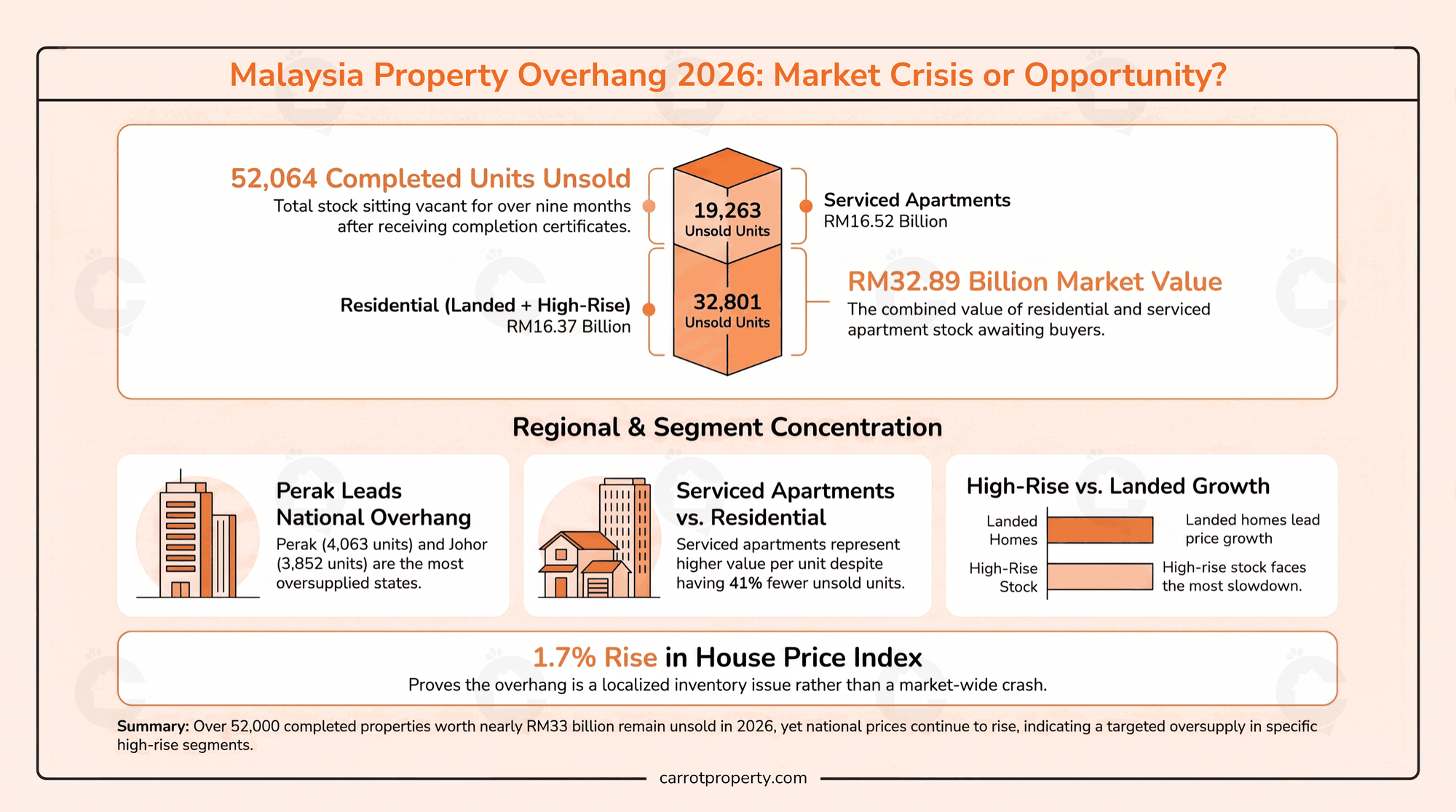
- Completed, unsold residential overhang reached 32,801 units, worth roughly RM16.37 billion — the sixth consecutive quarter this figure has risen.
- Unsold serviced apartments reached 19,263 units, worth around RM16.52 billion — almost matching the residential figure in value despite a smaller unit count.
- Combined, that's over 52,000 completed homes sitting unsold nationwide.
- Overall property transactions fell 8% year-on-year to 89,966, while transaction value slipped only 0.6% to RM51.09 billion.
- The Malaysian House Price Index rose 1.7% to 235.2 points, and the average home price increased to RM507,533 (from RM494,384 in Q3 2025).
- Bank Negara Malaysia has held the Overnight Policy Rate steady at 2.75% since May 2026, which keeps financing costs predictable but doesn't do anything to absorb existing unsold stock.
Put simply: this isn't a market crashing on price. It's a market where buyers are pickier, and where a growing pile of finished-but-unsold units is concentrated in specific segments and locations rather than spread evenly everywhere. The next two sections unpack exactly what that concentration looks like.
Why Fewer Deals Still Added Up to Nearly the Same Total Value
That 8% drop in transaction count against only a 0.6% drop in transaction value is worth sitting with, because it says something the headline numbers don't state outright. Working backwards from those two percentages: this year's 89,966 transactions at RM51.09 billion puts the average value per transaction at roughly RM567,800. The prior year's implied average, back-calculated the same way, works out closer to RM525,600 — a jump of roughly 8% in average transaction value, well above the 1.7% national House Price Index gain for the same period.
Those two figures shouldn't move that differently unless the mix of what's actually selling has shifted, not just the price of any one type of home. The more likely read: fewer entry-level and mass-market transactions are going through — the same segment where overhang is concentrated — while higher-value transactions have held up comparatively well. Terraced and semi-detached homes leading 2026's price growth (2.2%, versus 1.3% for high-rise) fits the same story: tighter-supply, higher-value segments are absorbing normally, while looser-supply, lower-to-mid-value high-rise stock is where both the slowdown and the overhang are showing up.
Is Property Overhang the Same as a Market Crash?
No — and the difference matters for how worried you should actually be. A market crash is a broad-based, market-wide decline: falling prices across most segments and locations at once, often paired with distressed or forced sales, negative equity, and a credit crunch that makes financing harder to get. None of that is what 2026's numbers show. The House Price Index rose 1.7% nationally, the OPR has sat steady at 2.75% since May, and — per the section above — the average value per transaction actually climbed rather than fell.
Overhang, by contrast, is a localised inventory problem: a growing pile of specific, completed units — concentrated in specific segments (high-rise, serviced apartments) and specific states — that haven't found a buyer within nine months of completion. It can sit alongside rising prices elsewhere in the same market, because the buyers who are active right now are being more selective about what they'll pay for, not disappearing from the market altogether. That's a real problem if you own, are trying to sell, or are considering buying into one of those specific overhang-heavy pockets — but it isn't the same thing as the broader market losing value.
Where the Overhang Actually Sits: By Property Type and By State
By property type, the two categories NAPIC tracks and reports on a routine basis are residential and serviced apartments — and one clarification is worth making upfront: serviced apartments sit on commercial land title, but they're residential in use — people live in them day to day. That's a different thing entirely from a shop office, retail lot, or SOVO/SOLO/SOFO unit, which are commercial-titled and used for actual business or office activity. Don't read "commercial title" as automatically meaning "commercial property" — the serviced apartment overhang figure is a housing problem, not a business-space problem.
Splitting the Q1 2026 total:
| Category | Unsold Completed Units | Value | Nature of Use |
|---|---|---|---|
| Residential (landed + high-rise) | 32,801 | RM16.37 billion | Housing |
| Serviced apartments | 19,263 | RM16.52 billion | Housing (commercial-titled land, residential use) |
| Combined | ~52,064 | ~RM32.89 billion | — |
NAPIC's routine public reporting doesn't break out a separate, comparable overhang figure for true commercial-titled, commercial-use stock — shop offices, retail lots, SOVO/SOLO/SOFO units bought for actual business or office purposes. That's a genuine data gap, not an oversight on our part: if you're specifically evaluating a shop-office or SOVO purchase, ask the developer or agent directly for that project's take-up rate, since a comparable national ratio isn't publicly tracked the way residential and serviced apartment overhang is.
By state, Q1 2026 data on completed unsold homes ranks Perak highest (4,063 units), followed by Johor (3,852), Selangor (3,745), Kuala Lumpur (3,733) and Penang (3,165). Perak topping the list is a useful reminder that overhang isn't purely a Klang Valley or Johor story — it shows up wherever supply has outpaced local demand, including smaller state capitals with slower population and job growth.
What Overhang Means If You're Buying
- Negotiating leverage. Developers sitting on unsold, completed stock are often willing to offer rebates, absorb legal fees, or throw in furnishing packages that they wouldn't offer on a fast-selling project. Overhang units are one of the few places where "just ask" genuinely works.
- Financing caution. Banks are aware of which projects and areas carry heavy overhang, and valuation can come in conservative as a result — meaning your margin of finance on an overhang-heavy unit may be lower than on a project with a clean take-up record. In practice, most buyers don't have a direct line to a bank's mortgage or property-financing desk to check this themselves, and calling in cold often reaches general customer service rather than the right department. The more realistic move in Malaysia is working with an experienced, well-connected property agent — one with existing relationships at the bank's loan officers can often pre-flag financing issues and smooth approval in a way a walk-in enquiry can't. WhatsApp Carrot Property if you'd like a recommendation before you commit to a unit.
- Resale liquidity. A unit bought in an overhang-heavy project or area may take longer to resell later, even if you got a good entry price — oversupply doesn't just affect the developer's ability to sell, it affects yours too.
If you'd rather sidestep overhang risk altogether, established, freehold projects with real existing tenant demand — rather than pure speculative launches — tend to sit in a different risk category. Carrot Property's own WCity OUG listings, The Maple Residences and Aras Residences, are anchored by an already-tenanted, owner-occupier-heavy neighbourhood rather than a purely speculative pipeline — worth a look if overhang risk is your main concern. Our OUG Property Guide goes deeper into what to check when picking an area for exactly this reason.
What Overhang Means If You're Investing
- Rental yield pressure. More unsold — and eventually rented-out — units in a corridor means more competition for tenants, which caps how much rent you can realistically achieve, regardless of what your unit is "worth" on paper.
- Entry pricing opportunity. The flip side: overhang-heavy projects sometimes offer a genuinely lower entry price for buyers with a long enough holding period to ride out the absorption cycle — but this only works if the underlying location has real long-term demand drivers, not just cheap launch pricing.
- Commercial-titled units aren't automatically "riskier" for overhang purposes — but they do have a narrower buyer pool. Whether a unit is covered by the Housing Development Act is a legal question about recourse if a developer defaults during construction; it has no direct bearing on whether a completed unit sits in oversupply. What does matter here: SOVO/SOLO/SOFO and shop-office units draw only investor and business buyers, with no owner-occupier demand to fall back on, which can mean slower absorption in a soft market. Financing terms aren't a reliable shortcut either — commercial property loans in Malaysia typically run 80–85% margin of finance (sometimes higher for strong applicants), which isn't consistently worse than residential financing, so a lower loan margin isn't proof of higher overhang risk.
Red Flags to Check Before You Commit
- Ask the sales team directly what percentage of completed units remain unsold, and for how long.
- Work with an experienced, well-connected property agent who can help verify financing feasibility with the bank ahead of time, rather than finding out only at the loan stage.
- Check the developer's track record and financial standing via SSM and past project delivery history.
- Compare the asking price against recent transacted prices for similar units in the same project or area, not just the developer's rebate headline.
FAQs
Is property overhang the same as a property market crash?
No. A crash is a broad-based price decline across the market; overhang is a localised, segment-specific inventory problem that can coexist with rising prices elsewhere — as it is in 2026, where the House Price Index rose even as overhang grew. See the full breakdown above.
Is property overhang good or bad news for buyers and investors?
It depends which side you're on. Overhang typically gives buyers more room to negotiate (rebates, fee absorption, furnishing packages) since developers are motivated to clear unsold, completed stock. It's a mixed picture for investors — cheaper entry pricing on one hand, tighter rental yields from oversupply on the other.
Are commercial-titled units always riskier than residential ones during an overhang?
Not for the reason many people assume. Whether a unit is covered by the Housing Development Act is a legal question about recourse if a developer defaults during construction — it doesn't determine oversupply risk. What can genuinely make commercial-titled units (SOVO/SOLO/SOFO, shop offices) more overhang-prone is a narrower buyer pool — investor and business buyers only, no owner-occupier demand — not their HDA status. Financing terms aren't a reliable signal either, since commercial loan margins vary by bank and applicant rather than following a fixed, consistently lower rule.
Which states have the most property overhang in 2026?
On Q1 2026 data for completed unsold homes, Perak led with 4,063 units, followed by Johor (3,852), Selangor (3,745), Kuala Lumpur (3,733) and Penang (3,165).
Does overhang affect my ability to get a home loan?
Indirectly, yes — banks factor in project- and area-level oversupply when valuing a unit, which can affect your margin of finance. In practice, though, few buyers have a direct line to the right person at the bank to check this in advance, and calling in cold often reaches the wrong department. Working with an experienced property agent who already has relationships with bank loan officers is the more realistic way most buyers in Malaysia get ahead of financing issues before they become a problem at the loan stage. WhatsApp Carrot Property if you'd like help finding the right agent for this.
This article is for general guidance only and does not constitute legal or financial advice. Overhang figures, state-level breakdowns, and market data are subject to revision as newer reporting periods are published — always verify current figures with a licensed real estate agent or your bank before making a purchase or investment decision.
See listings that aren't sitting in overhang
Carrot Property lists projects with genuine take-up and real tenant demand — honest numbers, no hard sell, so you can judge the actual risk for yourself.
- Verified Klang Valley listings
- Honest take-up & pricing breakdowns
- Straight answers, no hard sell