In This Guide
- The Short Answer: The Owner Pays, By Law
- What the Strata Management Act Actually Says
- Maintenance Fee vs Sinking Fund — What's the Difference
- How Commercial Maintenance Fees Are Calculated
- Can a Tenant Be Made to Pay Instead?
- What Happens If Maintenance Fees Go Unpaid
- Big Update: The July 2026 SST Exemption
- What to Check Before You Buy or Lease Commercial Property
- FAQs
Ask five property agents in Malaysia who's supposed to pay maintenance fees on a shop office or retail unit, and you'll likely get five confident, slightly different answers. The truth sits in a piece of legislation most owners have never actually read — and as of July 2026, there's a genuinely fresh development that has changed the numbers for anyone who owns commercial strata property. Here's what the law says, how commercial rates differ from residential ones, and what just changed.
The Short Answer: The Owner Pays, By Law
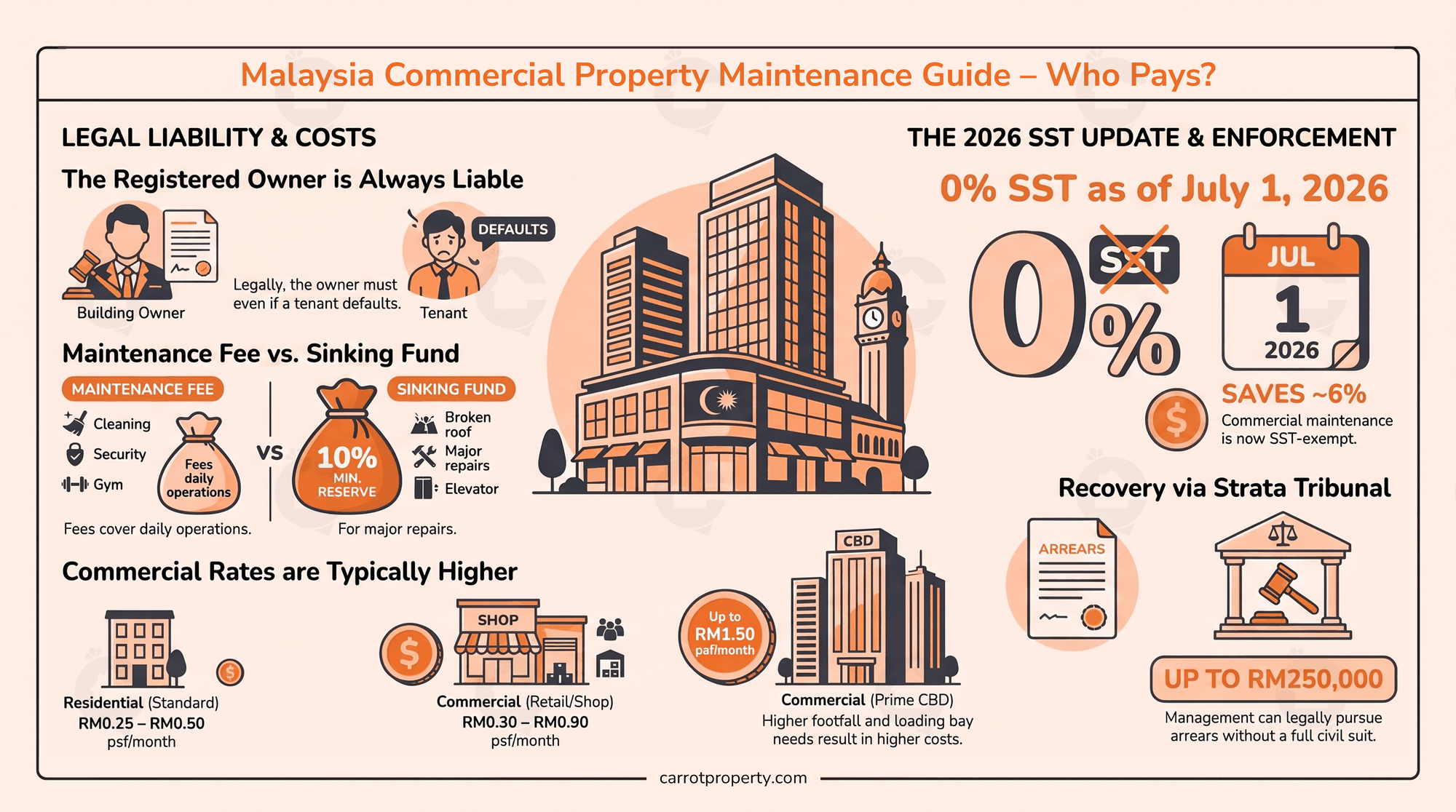
Under Malaysian law, the registered parcel owner — not the tenant — is legally obligated to pay maintenance charges and sinking fund contributions to the building's management body. This applies equally to residential and commercial strata units. A tenancy or lease agreement can require the tenant to reimburse the landlord or pay the amount directly, but that's a private arrangement between landlord and tenant. It does not change who the management body can legally chase if the bill goes unpaid — that's always the owner on record.
What the Strata Management Act Actually Says
The Strata Management Act 2013 (Act 757), in force since June 2015, governs how strata-titled properties in Malaysia are managed — this includes shop offices, retail units, and SoHo/SoFo commercial parcels within a strata scheme, not standalone landed shop lots with individual titles, which generally sit outside this framework.
Under Section 25 of the Act, every parcel owner must contribute to maintenance charges in proportion to the share units allocated to their parcel — larger or higher-value units carry a bigger share of the bill. Before individual strata titles are issued, the building is run by a Joint Management Body (JMB); once titles are issued to owners, a Management Corporation (MC) takes over. Both operate under the same statutory obligations, and an owner's payment duty carries over from one to the other.
Maintenance Fee vs Sinking Fund — What's the Difference
These two charges are often billed together but fund different things:
- Maintenance fee (service charge) — covers day-to-day running costs: security, cleaning, lift servicing, common-area utilities, and insurance for shared property.
- Sinking fund — a reserve for major, infrequent capital works: repainting, roof repairs, lift replacement. Under the Act, this must be set at a minimum of 10% of the maintenance charge, though owners can vote to raise it higher at an Annual General Meeting if the building's long-term repair needs justify it.
How Commercial Maintenance Fees Are Calculated
Maintenance fees across Malaysia typically range from about RM0.25 to RM1.50 per square foot, with the Klang Valley average sitting closer to RM0.25–0.50 psf for standard developments and prime addresses like KLCC or Bukit Bintang commanding more. Commercial parcels often land at the higher end of that range, reflecting heavier common-area use — more frequent cleaning from higher footfall, loading bay upkeep, and more intensive security than a typical residential floor requires.
Importantly, this differentiation is legally sanctioned, not arbitrary. In the landmark 2024 Court of Appeal case Aikbee Timbers Sdn Bhd & Anor v Yii Sing Chiu & Anor [2024] 1 MLJ 94, the court confirmed that developers and management corporations in mixed developments can set different maintenance rates for residential and commercial parcels — ensuring residential owners aren't subsidising a commercial unit's loading dock, and commercial owners aren't subsidising a pool or gym they'll never use.
| Segment | Typical Rate (psf/month) | What Drives the Cost |
|---|---|---|
| Residential — standard Klang Valley condo | ~RM0.25 – 0.50 | Pool, gym, lifts, general security |
| Commercial — shop office / retail unit | ~RM0.30 – 0.90 | Heavier footfall, loading bays, extended-hours security |
| Commercial — prime CBD (KLCC / Bukit Bintang) | Up to ~RM1.50 | Premium facilities, higher service standards |
The exact figure for any specific building depends on its operating budget and total share units — always request the latest approved budget from the JMB or MC rather than relying on a general benchmark.
Can a Tenant Be Made to Pay Instead?
In practice, yes — many commercial leases in Malaysia are structured so the tenant reimburses or directly pays the maintenance fee as part of the rental arrangement, similar to a triple-net lease structure. This is entirely legal and common for office and retail space.
What doesn't change is the underlying legal relationship: the tenant has no direct contractual tie to the JMB or MC. If a tenant stops paying, the management body pursues the registered owner, full stop — recovering the shortfall from a defaulting tenant then becomes a separate matter between landlord and tenant, governed by the lease agreement rather than the Strata Management Act. Owners leasing out commercial units should build clear default and recovery clauses into their tenancy agreements rather than assuming the pass-through arrangement protects them.
What Happens If Maintenance Fees Go Unpaid
Arrears on maintenance charges and sinking fund contributions are a genuine enforcement risk, not just an administrative nuisance:
- Late payment interest — by-laws commonly allow interest on overdue amounts, in some buildings up to 10% per annum.
- Strata Management Tribunal — for claims up to RM250,000, the JMB or MC can file for recovery through the Tribunal (under Section 105 of the Act), which handles the large majority of arrears and charge disputes without needing a full civil suit.
- Civil action — for larger sums beyond the Tribunal's jurisdiction, recovery proceeds through the courts.
- Restricted access — some MCs restrict shared-facility or parking access for units with significant arrears, subject to their by-laws.
Big Update: The July 2026 SST Exemption
Here's the part of this story that's genuinely new. Since 26 February 2024, maintenance and sinking fund charges billed to commercial unit owners were subject to 6% Service Tax (SST) — while residential owners were exempted from SST on the same charges starting 1 April 2024. That gap meant a commercial owner effectively paid 6% more than a residential owner for functionally the same service.
That changed on 1 July 2026. Under Service Tax Policy 3/2026, maintenance and repair services — including maintenance management services — provided by a JMB or MC in relation to non-residential (commercial) premises are now classified as non-taxable, via a ministerial exemption. In practice, on a RM5,000 monthly commercial maintenance bill, that's roughly RM300 a month no longer charged.
What to Check Before You Buy or Lease Commercial Property
- 1Request 2 years of AGM minutes and financial statements.Look for accumulating arrears, a thin sinking fund, or unresolved disputes flagged at past meetings.
- 2Confirm the exact psf maintenance rate — and whether it's differentiated from residential.In mixed developments, ask for the commercial-specific rate and budget breakdown, not a blended average.
- 3Buying via auction? Get the arrears position confirmed in writing.Don't rely on the general principle alone — the July 2026 ruling helps, but building-specific facts still matter.
- 4Leasing out the unit? Put the fee pass-through in writing in the tenancy agreement.And remember: you, the owner, stay liable to the MC regardless of what the lease says.
- 5Check whether your latest invoice already reflects the SST exemption.If it's dated after 1 July 2026 and still shows 6% SST on the maintenance line, query it with the JMB or MC treasurer.
FAQs
Is maintenance fee the same as quit rent or assessment (cukai pintu)?
No. Quit rent is paid to the state land office and assessment (cukai taksiran/cukai pintu) is paid to the local council — both are government levies. Maintenance fee and sinking fund are paid separately to the JMB or MC for building upkeep. A commercial owner needs to track all three as distinct bills.
Do commercial units really pay more than residential units in the same building?
Often yes, on a per-square-foot basis, reflecting heavier common-area use — but the rate must be set fairly and transparently, per the Aikbee Timbers precedent, not set arbitrarily higher without justification.
My tenancy agreement says the tenant pays the maintenance fee, but they've stopped paying. What now?
The JMB or MC will still pursue you as the registered owner, since the tenant has no direct legal relationship with the management body. Recovering the shortfall from your tenant is then a separate matter under your tenancy agreement.
Does the July 2026 SST exemption apply to residential maintenance fees too?
Residential maintenance fees have already been SST-exempt since 1 April 2024. The July 2026 change specifically closes the gap that previously existed for commercial and other non-residential premises.
What's the difference between a JMB and an MC?
A Joint Management Body manages the property before individual strata titles are issued to owners. A Management Corporation takes over once titles are issued. Both operate under the Strata Management Act 2013, and an owner's payment obligations carry over from one to the other.
Can I dispute a maintenance fee I think is too high?
Yes — raise it at the AGM, request a full breakdown of the operating budget, or if there's a genuine unresolved grievance, escalate it to the Strata Management Tribunal under the Act.
This article is for general guidance only and does not constitute legal or financial advice. Tax treatment, statutory rates, and case law referenced here are subject to change — always verify current figures with your JMB/MC, a licensed tax advisor, or a lawyer before making a decision.
Get the real numbers before you commit
Carrot Property helps buyers and investors cut through the fine print on Malaysian property — maintenance rates, tenancy terms, and what a listing actually costs to hold. No hard sell, just honest answers.
- Verified Klang Valley listings
- Honest cost breakdowns
- Straight answers, no hard sell